RCVD-CHAPTER 12 Chassis Set-up
Introduction
In this chapter we discuss specific problems that may arise in tuning an existing car for a given race track. The list of problems discussed and the possible solutions offered are based on the authors'experiences and are by no means complete. As far as we know, the suggested remedies are accurate but there will always be exceptions; the following material should be treated as a guideline, not as "gospel."
在本章中,我们将讨论为特定赛道调校现有赛车时可能遇到的具体问题。所讨论的问题清单及提供的可能解决方案基于作者的经验,绝非完整无遗。据我们所知,建议的解决方案是准确的,但总会有例外情况;以下内容应视为指南,而非"金科玉律"。
When discussing car set-up it is necessary to make the distinction between changes that will always improve the performance of the car (make all of these first) and changes that tune or balance the car (these.have trade-offs). In the first category are things like more power and stickier tires; the second category includes small changes in such things as spring rates or anti-roll bars. It takes both good initial design and careful tuning to produce a successful car.
讨论赛车调校时,有必要区分两类调整:一类是总能提升赛车性能的调整(优先进行所有这些调整);另一类是用于微调或平衡赛车的调整(这些调整需要权衡取舍)。第一类包括增加动力、使用抓地力更强的轮胎等;第二类则涉及诸如弹簧刚度或防倾杆等部件的微小调整。要打造一台成功的赛车,既需要出色的初始设计,也离不开细致的调校。
One major cause of handling problems, suspension/component/chassis compliance (or flexibility) is not discussed in this chapter at all, because. it is more a function of the vehicle design. As noted in the quote at the start of Chapter 23, every engineering material is flexible to some degree. Loads in various parts of a car can be surprisingly large, leading to unexpected distortion. Compliance often occurs in components that are structurally in bending, instead of straight compression/tension. With unknown and/or excessive compliance, it will be very difficult to predict any aspect of race car performance. Cars that have large compliances (often unknown by the team) are often unresponsive to the standard changes to which other cars respond.
导致操控问题的一个主要根源——悬架/部件/底盘的柔顺性[compliance](或柔性)——本章将完全不讨论,因为这更属于车辆设计范畴的问题。正如第23章开篇引文所指出的,所有工程材料都具备一定程度的柔性。赛车各部件的载荷可能大得惊人,从而导致意外的变形。柔顺性[compliance]通常发生在结构上承受弯曲而非单纯拉伸/压缩的部件中。如果柔顺性[compliance]未知和/或过大,将很难预测赛车的任何性能表现。柔顺性[compliance]过大的赛车(车队通常并不知情)往往对其他赛车有反应的标准调校调整没有反应。
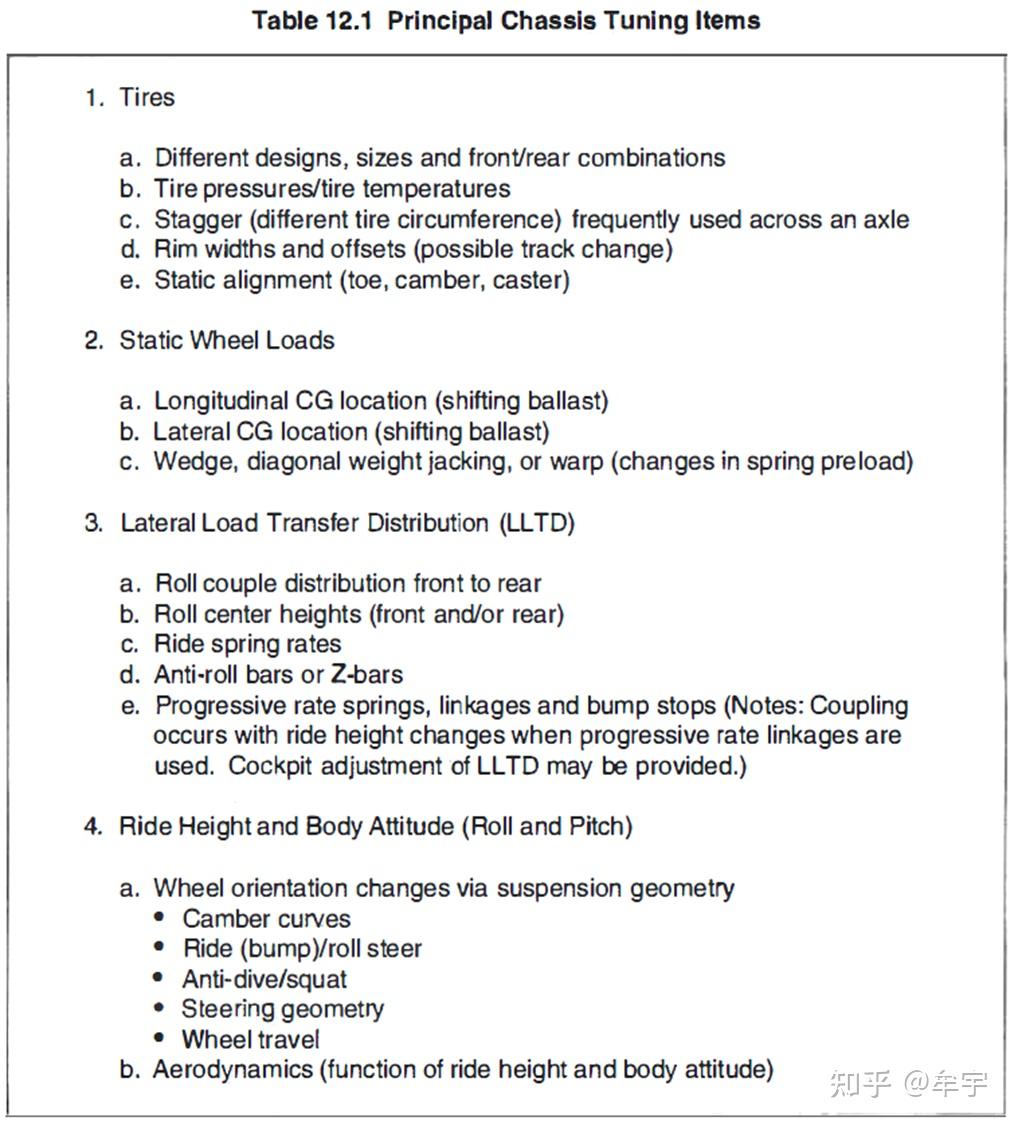
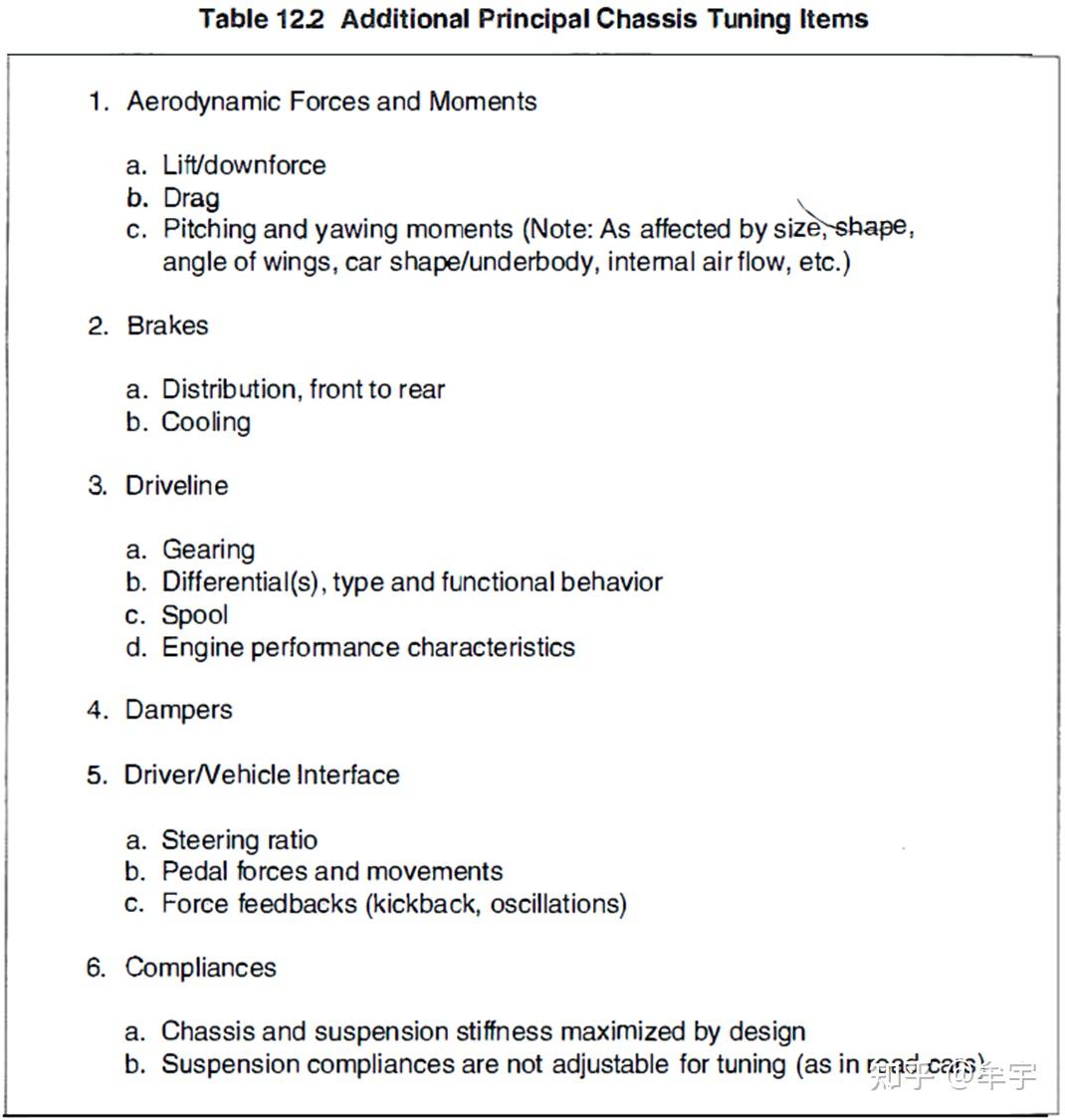
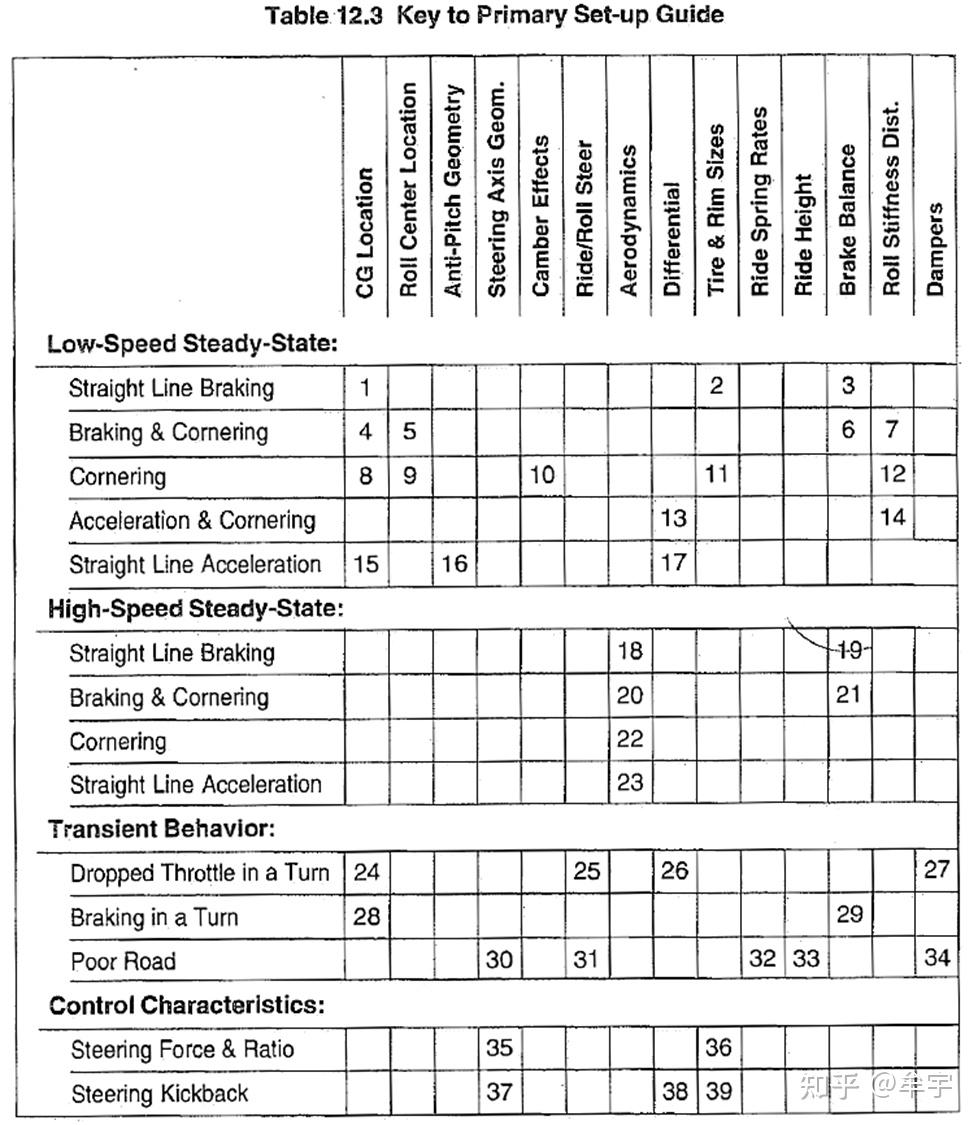
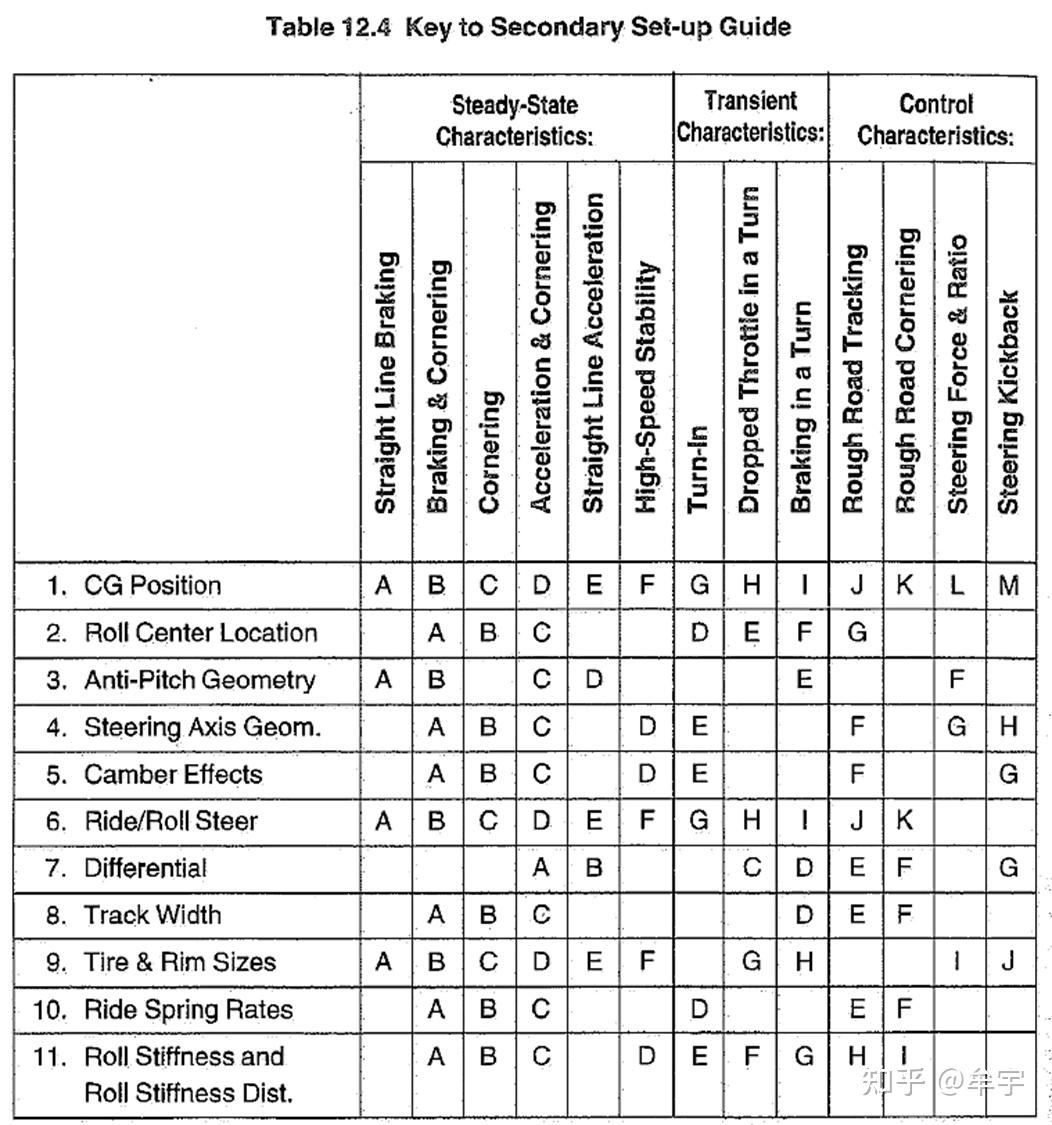
This chapter is keyed to several tables. Tables 12.1 and 12.2 list the principal chassis adjustments that can be made on a modem race car. You can consult Table 12.3 with a known problem in mind, and it will point to changes that should have a large influence on the problem. The challenging part of racing set-up is that everything affects every-thing else. A change made to improve one aspect of performance of a car can easily degrade its overall performance. The best lap time is made with the set-up that is the best compromise for the circuit as a whole, including the driver. Table 12.4 puts this into perspective by pointing out some of the effects that will occur when a particular change is made to improve some particular problem.
本章内容与多个表格相关联。表12.1和12.2列出了现代赛车上可进行的主要底盘调整。你可以带着已知问题查阅表12.3,它会指出对该问题应有较大影响的调整方向。赛车调校的挑战性在于,所有因素都相互影响。旨在改善赛车某一方面性能的调整,很容易降低其整体性能。最佳圈速来自于针对整个赛道(包括车手)的最佳折衷调校方案。表12.4通过指出为改善某个特定问题而进行特定调整时可能产生的一些效果,帮助我们更全面地看待这个问题。
Given the differences between cars,. this set of tables can only be considered a starting point in the set-up process. Ideally, enough testing will be done to put numbers on the size of the effect of a given change. This test data will be invaluable at the track when time is short.
鉴于车辆之间存在差异,这套表格只能被视为调校过程的起点。理想情况下,应进行足够的测试,以量化特定调整的效果大小。这些测试数据在赛道时间紧迫时将具有无可估量的价值。
12.1 Set-up
Racing is all about driving the vehicle at its limits, near the boundary of the "g-g" diagram. Finding a vehicle configuration which can be driven to produce this desired performance is referred to as setting up or chassis tuning. It is a difficult task requiring many compromises to fit each circuit and the driver's capabilities and preferences. Often it will not be possible to achieve the optimum set-up in the available testing and practice time and the driver will have to allow for the vehicle deficiencies that remain.
赛车运动的核心在于将车辆驾驶至极限,接近"g-g"图(加速度图)的边界。寻找一种能够通过驾驶实现此理想性能的车辆配置,即被称为调校或底盘调校。这是一项艰巨的任务,需要为每条赛道以及车手的能力与偏好做出诸多权衡取舍。通常,在有限的测试和练习时间内可能无法达成最佳调校,车手将不得不适应车辆依然存在的不足。
The principal objectives in setting up the car are:
- Cornering balance (neutral steer) under max lateral conditions.
- Compromise between cornering performance and drag on high-speed tracks.
- Eliminating specific control and stability problems at any points on the circuit as reported by the driver.
调校赛车的主要目标如下:
- 在最大侧向加速度条件下保持过弯平衡(中性转向)。
- 在高速赛道上,权衡过弯性能与空气阻力。
- 根据车手反馈,消除赛道上任何特定点的操控或稳定性问题。
The traditional set-up procedure is to make changes in vehicle adjustments based on subjective driver comments, and lap and segment times.These might be supplemented with remarks from observers stationed at various points around the track and tire temperature measurements taken in the pits.
传统的调校流程是基于车手的主观评价、圈速及分段成绩来调整车辆设置。这些信息可辅以分布在赛道各处的观察员的记录,以及在维修区测量的轮胎温度数据。
The professional racing approach to set-up has become much more sophisticated in recent years. In the first place, the cars have become more adjustable. Second, electronic on-board and track-side instrumentation is being used by most well-financed teams. Services of this type are also available on a rental basis. When the stakes are high enough, set-up approaches design and major overnight changes may be made in the vehicle. For example, extensive modification might be applied to an aerodynamic surface or several alternatives may be made available.
近年来,职业赛车领域的调校方法已变得复杂精密得多。首先,赛车的可调校性大为增强。其次,大多数资金充裕的车队都在使用车载及赛道侧的电子仪器设备。此类服务也可按需租赁。当比赛至关重要时,调校工作近乎重新设计,并且可能对赛车进行重大的连夜修改。例如,对空气动力学表面进行大幅改动,或准备多个备选方案。
**1. 轮胎**
a. 不同设计、尺寸及前后轮组合;b. 胎压/胎温;c. 轴间常用直径差(左右轮胎圆周不同);d. 轮辋宽度与偏距(可能改变轮距);e. 静态定位参数(前束、外倾角、主销后倾角)
**2. 静态轮荷**
a. 纵向重心位置(移动配重);b. 横向重心位置(移动配重);c. Wedge(楔形配重?)、对角重量调整或扭曲(通过改变弹簧预载实现)
**3. 横向载荷转移分配**
a. 前后侧倾力矩分配;b. 侧倾中心高度(前和/或后);c. 悬架弹簧刚度;d. 防倾杆或Z型杆;e. 渐进刚度弹簧、连杆与缓冲块(注:使用渐进刚度连杆时,载荷转移会随行驶高度变化而产生耦合效应。可在驾驶舱内调整LLTD。)
**4. 行驶高度与车身姿态(侧倾与俯仰)**
a. 通过悬架几何结构改变车轮定位
• 外倾角变化曲线
• 行驶(颠簸)/侧倾转向特性
• 抗点头/抗后坐几何
• 转向几何
• 车轮行程
b. 空气动力学效应(随行驶高度与车身姿态变化)
Chassis Adjustment
Tables 12.1 and 12.2 cover the principal items that are used in tuning the chassis. No such list can be viewed as final, since competition experience and ingenuity are continually producing new ideas.
表12.1和表12.2涵盖了底盘调校中使用的主要项目。此类列表不应被视为最终版本,因为竞赛经验和创新才智正持续催生新的理念。
An examination of the list in Tables 12.1 and 12.2 will indicate that the major part of tuning is concerned with maximizing the lateral tire forces while achieving the proper balance. Items 1-4 in Table 12.1 are directly concerned with the tires themselves, desirable wheel orientations, and tire loads. The aerodynamic lift/downforce of item 1 in Table 12.2 is an important component of the vertical tire loads when aero devices are allowed. Brake distribution, item 2 in Table 12.2, affects control and balance via modification to the tire loads and through the friction circle. Driveline characteristics acting through the interaction of longitudinal and lateral tire slip can significantly affect the available lateral tire forces. Finally, dampers have some direct control on tire loads under rough road and transient conditions.
审视表12.1和表12.2中的列表可以发现,调校的主要部分在于最大化轮胎横向力的同时实现恰当的平衡。
表12.1中的第1至4项直接涉及轮胎本身、理想的车轮定位以及轮胎载荷。当允许使用空气动力学装置时,表12.2第1项中的气动升力/下压力是轮胎垂直载荷的重要组成部分。表12.2第2项的制动分配,则通过改变轮胎载荷以及利用摩擦圆来影响操控性与平衡性。通过轮胎纵向与横向滑移的相互作用,传动系统特性会显著影响可用的轮胎横向力。最后,减震器在颠簸路面和瞬态条件下对轮胎载荷有一定的直接控制作用。
Although it is generally desirable to make one configuration change at a time, there are interactions between changes which must be understood.
尽管通常建议每次只进行一项配置更改,但必须理解各调整项目之间存在的相互影响关系。
1. 空气动力学力与力矩
a. 升力/下压力;b. 阻力;c. 俯仰与横摆力矩(注:受翼片尺寸、角度、车身形状/底板、内部气流等因素影响)
2. 制动系统
a. 前后制动力分配;b. 冷却
3. 传动系统
a. 传动比;b. 差速器类型与功能特性;c. 硬轴连接 d. 发动机性能特性
4. 减振器
5. 车手/车辆交互界面
a. 转向传动比;b. 踏板力与行程;c. 力反馈(反冲、振动)
6. 柔顺性
a. 通过设计最大化底盘与悬架刚度;b. 悬架柔顺性不可用于调校(与民用车辆不同)
12.2 Primary Set-up
Table 12.3 is a first cut at the major problem areas for high-performance/ racing cars. Down the left side of the table is a list of different operating conditions and across the top is a list of items that can be changed. The numbers in the chart correspond to the numbered paragraphs in this section on Primary Set-up. The choice of which. relationships to discuss was made on the basis of "most likely to affect performance." As an aid to understanding, we recommend that the reader stop and create a mental picture for each situation.
表12.3是对高性能/赛车主要问题领域的初步划分。表格左侧列出了不同的运行工况,顶部则列出了可进行调整的项目。图表中的数字对应本章"基础调校"部分中带编号的段落。选择讨论这些关系是基于其"最有可能影响性能"的原则。为帮助理解,我们建议读者在阅读时稍作停顿,针对每一种情境在脑海中构想其具体画面。
The changes along the top of the table are ordered from left to right in approximate mechanical difficulty. Changes on the left side of the table require a fair amount of effort and mat need to be designed into the car; those on the right are items that can be changed relatively easily in tuning the car.
表格顶部的调整项目大致按照机械调整难度从左到右排列。表格左侧的更改需要相当的工作量,且可能需要预先设计到车辆中;而右侧的项目则是在调校车辆时可以相对轻松更改的内容。
■ Straight Line Braking(Low-Speed Steady-State)
1. The Effect of CG Location on Straight Line Braking重心位置对直线制动的影响
When the brakes are applied, load is transferred from the rear tires to the front tires. The higher the CG, the more is transferred for any given deceleration. Tires are load sensitive, thus theoretical best braking occurs with the tires evenly loaded (if the tires are the same on both ends of the car). For the typical RWD or FWD road car (with initial forward load bias) this says that to improve the absolute level of braking, the CG should be as low as possible and moved toward the rear of the car. Clearly this is not always feasible for FWD race cars but it should be taken into account when a car is being designed.
当施加制动时,载荷会从后轮转移到前轮。对于任何给定的减速度,重心越高,转移的载荷就越多。轮胎具有载荷敏感特性,因此,如果车辆前后轮胎相同,理论上最佳的制动效果出现在轮胎均匀受载时。对于典型的后轮驱动或前轮驱动的民用车(初始载荷偏向前方)来说,这意味着要提高绝对制动水平,重心应尽可能低并向车辆后部移动。显然这对于前轮驱动的赛车并不总是可行,但在车辆设计时应予以考虑。
2. The Effect of Tires and Rim Sizes on Straight Line Braking轮胎和轮辋尺寸对直线制动的影响
To the extent that changing the tires/rims changes tire/road friction properties, the. braking performance will be affected. The end with the stickiest tires can generate relatively more braking force for the load on it.
改变轮胎/轮辋尺寸会改变轮胎与路面的摩擦特性,从而影响制动性能。装有抓地力更强轮胎的一端,能为其所承载的负荷提供相对更大的制动力。
3. The Effect of Brake Balance on Straight Line Braking制动平衡对直线制动的影响
Brake balance is the name given to the proportioning of brake force (or brake torque) to the front and rear tires. The brake balance to give "correct" proportions of braking to the front and rear (relative to their potential) varies with deceleration rate. The harder the stop, the more heavily loaded will be the front wheels and the more braking effort they can support. Likewise, the rear tires are unloaded as the deceleration increases and they must have less braking force. This is accomplished in several ways: Either the brake balance is fixed and is biased heavily toward the front, which means the rears don't do their share on relatively gentle stops, or various types of proportioning valves are used to limit hydraulic pressure to the rear brakes to prevent premature locking. Finally, an anti-lock system may be fitted.
制动平衡[Brake balance]是指制动力(或制动力矩)在前、后轮胎之间的分配比例。为前、后轮提供“正确”(相对于其潜力而言)制动比例的制动平衡,会随减速度的变化而变化。制动越猛烈,前轮载荷越大,它们能支持的制动力也越大;同样,随着减速度增加,后轮载荷减小,其制动力也必须减小。这可以通过几种方式实现:要么采用固定且严重偏向前轮的制动平衡(这意味着在相对平缓的制动时后轮未能发挥其应有作用);要么使用各种类型的比例阀来限制后轮制动液压,以防止过早抱死;最后,也可以加装防抱死系统[ABS]。
When the brakes are not correctly set up (for racing) one end will lock up before the other. If the rears lock first, the car will tend to spin, based on the destabilizing side force that the still-rolling front tires provide. If the fronts lock up first. steering control will be lost and the car will go straight or slide down the camber of the road. Because the desirable brake balance varies with the, deceleration, different brake balances are required on different coefficient of friction surfaces. For example, snow gives little absolute braking capability and the best brake balance will be very close to the fore-aft static weight distribution. Where possible, it is desirable to fit some sort of brake balance adjustment to race cars to allow tuning of the brakes to different surfaces and conditions.
当制动系统(针对赛车用途)未正确调校时,车辆一端会先于另一端抱死。若后轮先抱死,基于仍在滚动的前轮所产生的不稳定侧向力,车辆将倾向于发生甩尾。若前轮先抱死,则会丧失转向控制,车辆将沿直线滑行或顺路面横向坡度侧滑。由于理想的制动平衡随减速度变化,不同摩擦系数的路面需要不同的制动平衡设定。例如,雪地提供的绝对制动力很小,其最佳制动平衡会非常接近前后静态重量分布。在条件允许的情况下,为赛车配备某种制动平衡调节装置是值得期待的,以便针对不同路面和工况对制动系统进行调校。
■ Braking and Cornering(Low-Speed Steady-State)
4. The Effect of CG Location when Braking and Cornering制动与转向联合工况下重心位置的影响
The result of combined braking and cornering on tum entry is to load the outside front wheel very heavily(perhaps as much as one half the weight of the car). At the same time, the inside rear wheel is lightly loaded. The higher the CG, the more load will be transferred. This situation will be exaggerated if the CG is forward to begin with. The heavily loaded outside front tire will be operating at a relatively low coefficient because of load sensitivity. Assuming the car has been otherwise set up, a low and rearward CG position is going to keep the tires most evenly loaded on tum entry, and this will give the best performance.
在入弯时同时进行制动和转向,会导致外侧前轮承受极重的载荷(可能高达车重的一半)。与此同时,内侧后轮则载荷较轻。重心越高,载荷转移量越大。如果重心本身靠前,这种情况会更加严重。由于载荷敏感特性,承受重载的外侧前轮将在相对较低的摩擦系数下工作。假设车辆在其他方面已设置妥当,较低且靠后的重心位置将使轮胎在入弯时载荷分布最为均匀,从而提供最佳性能。
5. The Effect of Roll Center Location when Braking and Cornering 侧倾中心位置在制动与转向联合工况下的影响
Roll center heights front and rear partially determine the way the roll moment on the car from lateral force is distributed. Lowering the roll center on one end will lower the roll moment resisted by that end; the wheels on that end will be more evenly loaded in cornering compared to the other end of the car. For example, assume that the car is loose on tum entry; the idea is to sacrifice grip on the front to increase grip on the rear. The outside front is taking the largest share of the load and increasing the front roll resistance by raising the front roll center will further degrade. it to help the rear stick proportionately better. Additional help can be obtained by lowering the rear roll center height as well. It should be noted that "too high" a roll center leads to jacking.
前后侧倾中心高度部分决定了由侧向力引起的车身侧倾力矩的分配方式。降低某一端的侧倾中心会减少该端所抵抗的侧倾力矩;在转向时,与车身另一端相比,该端的车轮将承受更均匀的载荷。例如,假设车辆在入弯时存在甩尾趋势;思路是牺牲前轮抓地力以增加后轮抓地力。外侧前轮承担了大部分载荷,通过提高前侧倾中心来增加前侧倾阻力,将进一步削弱其性能,从而相对地帮助后轮获得更好的抓地力。通过同时降低后侧倾中心高度可以获得额外的帮助。需注意,过高的侧倾中心会导致"起升效应"[jacking,顶升效应]。
6. The Effect of Brake Balance on Combined Braking and Cornering制动平衡对联合制动与转向的影响
The correct brake balance for straight line stopping may not be appropriate on tum entry. The outside front tire is very heavily loaded and generates relatively more lateral force than the rear leading to spin. This is true even though the front is operating at a lower coefficient (due to load sensitivity). Thus, too much rear brake bias may be described as "loose coming into the turn."
适用于直线制动的正确制动平衡,在入弯时可能并不合适。外侧前轮载荷极大,其产生的侧向力相对后轮更多,容易导致转向过度(甩尾)。即使前轮因载荷敏感性而在较低摩擦系数下工作,情况也是如此。因此,过大的后轮制动力分配可描述为"入弯甩尾"。
Some production cars have almost no rear brake bias (to prevent accidental spins) and the sometimes-used practice of trail braking (braking while on the throttle in a front-wheel drive} has a compensating effect. The engine power reduces the braking on the front wheels while the rears are still receiving a normal amount of braking force. The result is that the rear tires are saturated and the car begins to spin; carefully controlled, this can be used to get the tail out on entry to tight corners.
一些量产车几乎没有后轮制动力分配(为防止意外甩尾),而有时采用的循迹刹车[trail braking]技术(在前轮驱动车辆中带着油门刹车)具有补偿效果。发动机动力降低了前轮的制动力,而后轮仍在接收正常的制动力。结果是后轮先达到附着极限,车辆开始甩尾;若控制得当,可利用此效应在进入急弯时使车尾向外摆动。
7. The Effect of Roll Stiffness Distribution when Braking and Cornering侧倾刚度分配在制动与转向联合工况下的影响
The roll stiffness distribution is the other way of changing the loads on the wheels under lateral force. Roll stiffness can be raised by increasing anti-roll bar stiffness or increasing spring stiffness. Again, assuming the car is loose on tum entry, it is appropriate to resist more of the body roll moment on the front Higher front roll stiffness will do this. If the car has a "rising rate" spring installation, the front roll stiffness increases when the vehicle pitches forward.
侧倾刚度分配是在侧向力作用下改变车轮载荷的另一种方式。可通过增加防倾杆刚度或弹簧刚度来提高侧倾刚度。再次假设车辆入弯甩尾,适当增加前部抵抗车身侧倾力矩的能力是合适的。更高的前侧倾刚度可实现此目的。如果车辆安装了"递增刚度"弹簧,当车辆向前俯仰时,前侧倾刚度会增加。
For front-wheel drive the problem may be reversed, if the CG of the car is so high and/or forward that the inside rear wheel is off the ground, the rear of the car is already offering all the roll stiffness it can and further changes in rear roll stiffness will have no effect.
对于前轮驱动车辆,问题可能相反。如果车辆重心过高和/或过于靠前,导致内侧后轮离地,那么车辆后部已经提供了其所能提供的全部侧倾刚度,进一步改变后侧倾刚度将不会产生效果。
■ Steady-State Cornering(Low-Speed Steady-State)
8. The Effect of CG Location on Steady-State Cornering重心位置对稳态转向的影响
A neutral car is best for steady-state cornering. By tuning, cars with a range of CG positions near the center of the car (and same tires front and rear) can be made to be neutral. If the CG is forward, the lightly loaded rear end will stick better than the front (because of tire load sensitivity) and the rear end must be degraded to bring the car back to neutral (this ignores the friction circle effect which can degrade the drive tires a great deal, even at road load power). The best use of equal-sized tires in steady state cornering is made with the CG near the center of the car.
对于稳态转向而言,具有中性转向特性的车辆最为理想。通过调校,可以使重心位置靠近车辆中心区域(且前后轮胎相同)的各类赛车呈现中性转向特性。若重心靠前,则载荷较轻的后端抓地力将优于前端(由于轮胎的载荷敏感性[tire load sensitivity]),此时必须降低后轮性能以使车辆恢复中性转向(此分析暂未考虑摩擦圆效应,该效应即使在常规负载功率下也可能显著降低驱动轮的抓地力)。在稳态转向中,要充分发挥等尺寸轮胎的性能,最佳方案是将重心设置在靠近车辆中心的位置。
9. The Effect of Roll Center Location on Steady-State Cornering侧倾中心位置对稳态转向的影响
If the car is forward weight biased, a rear roll center higher than the front will tend to make it neutral. If both roll centers are so low (i.e., on the ground) that the car has a large amount of body roll, absolute cornering performance may be affected through adverse tire camber. It is necessary to strike a compromise here because too high a roll center leads to jacking (and lateral tire scrub on bumps), an undesirable characteristic.
若车辆存在前轴重量偏置,将后侧倾中心设置得高于前侧倾中心有助于车辆趋向中性转向。如果前后侧倾中心均过低(例如接近地面),导致车身产生较大侧倾,则可能因不利的轮胎外倾角变化而影响绝对转向性能。此处需要做出折衷,因为过高的侧倾中心会导致起升效应(及颠簸路面的轮胎横向滑移),这是不理想的特性。
10. The Effect of Camber on Steady-State Cornering外倾角对稳态转向的影响
It is desirable to have a small amount of negative camber (top of the tire leaning toward the center of the car) on the outside wheels. This produces the maximum lateral force from the two outside tires. Tire temperature taken across the tread width is commonly used to set static camber; the camber is changed until the temperature is roughly the same across the tread width. For race courses where the direction of tum is always (or mostly) the same, positive camber on the inside wheels will also help. Camber can also be used to balance the car.
理想情况下,外侧车轮应设置少量负外倾角(轮胎顶部向车辆中心倾斜)。这能使两个外侧轮胎产生最大的侧向力。通常通过测量胎面宽度方向的温度来设定静态外倾角:调整外倾角直至胎面各区域温度基本一致。对于转向方向始终(或主要)相同的赛道,内侧车轮采用正外倾角也会有所帮助。外倾角也可用于平衡车辆转向特性。
11. The Effect of Tire and Rim Sizes in Cornering轮胎与轮辋尺寸对转向的影响
Cornering stiffness is often a function of tire/rim size, aspect ratio, and width. As has been mentioned earlier, higher cornering stiffness tires require lower slip angles to produce a given amount of lateral force. Lower slip angles means lower "induced drag" or scrub and less speed loss in cornering. The optimum rim width may also play a part in maximizing the total grip available from a given tire.
轮胎的侧偏刚度通常与其尺寸、扁平比和宽度相关。如前所述,高侧偏刚度的轮胎只需较小的侧偏角即可产生给定的侧向力。更小的侧偏角意味着更低的"诱导阻力[induced drag]"或滑移摩擦,从而减少转向时的速度损失。最佳轮辋宽度也可能对发挥特定轮胎的最大总抓地力起到作用。
12. The Effect of Roll Stiffness Distribution on Steady-State Cornering侧倾刚度分配对稳态转向的影响
For a symmetrical car (50% weight on the front wheels, 4WD, etc.), the roll stiffness would ideally be the same on front and rear, if steady cornering were to be optimized. In 2WD cars, the drive degrades the lateral force capability at that end and the roll stiffness is biased toward the undriven end. Many suspensions (especially rear) have an anti-roll bar "built-in" (twist axles). These double-duty suspensions require care in calculating the roll stiffness.
对于对称设计的车辆(前轮载荷50%、四轮驱动等),若要优化稳态转向性能,理想情况下的前后侧倾刚度应相同。在两轮驱动车辆中,驱动端会降低该端的侧向力能力,因此侧倾刚度应偏向非驱动端。许多悬架(尤其是后悬)具有"内置"防倾杆功能(如扭转梁式悬架)。这类具备双重功能的悬架在计算侧倾刚度时需要特别注意。
■ Acceleration Out of a Corner(Low-Speed Steady-State)
13. The Effect of Differential Type on Acceleration Out of a Corner差速器类型对出弯加速的影响
With an open differential the lightly loaded inside wheel is free to spin up under power if enough torque is available. This limits the available acceleration. Limited slip differentials have been used with varying success. It is unlikely that the simple addition of such a differential will be successful. As with any major change, a period of development must be gone through to make the new set-up work. The type of limited slip differential chosen will be very important. Undesirable jerkiness occurs with many types and experience has shown this to be undesirable for combined acceleration and turning.
对于开放式差速器,若动力充足,载荷较轻的内侧车轮在动力下容易空转。这会限制可用的加速度。限滑差速器被使用的效果各有不同。但单纯加装这类差速器可能难以成功。与任何重大改动一样,必须经过一段时间的开发调试,才能使新的配置生效。所选限滑差速器的类型至关重要。许多类型会产生不良的顿挫感,经验表明这在加速与转向联合工况下是不可取的。
The locked rear end or spool is another common solution to the problem of wheel spin. Because the locked axle has high resistance to yaw, more front cornering power may be required to keep the car neutral. If all the turns are the same direction, stagger (differential tire circumference) may be used to "split the difference" between low drag when straight running and when turning.
锁死后轴或使用硬轴连接是解决车轮打滑问题的另一种常见方案。由于锁死的车轴对横摆运动阻力很大,可能需要更强的前端转向能力来保持车辆的中性转向特性。如果所有弯道方向相同,可以使用轮胎直径差(左右轮胎圆周不同)来"折衷平衡"直线行驶的低阻力和弯道行驶的需求。
14. The Effect of Roll Stiffness Distribution on Acceleration Out of a Corner侧倾刚度分配对出弯加速的影响
Roll stiffness is the easy way to change lateral load transfer distribution. For rear-wheel drive the tendency is to spin the inside rear; more roll stiffness on the front (less on the rear) will help this. On the other hand, acceleration from low speed can reduce. the front tire load so much that the car plows.
侧倾刚度是改变横向载荷转移分配的简便方法。对于后轮驱动车辆,内侧后轮容易打滑;增加前部侧倾刚度(减少后部侧倾刚度)将对此有所帮助。另一方面,低速加速可能大幅减少前轮载荷,导致车辆出现推头现象。
For front-wheel drive, if the inside front wheel is spinning on acceleration out of a low-speed comer, more rear roll stiffness will help if the inside rear wheel isn't in the air.
对于前轮驱动车辆,如果在低速弯出弯加速时内侧前轮打滑,且内侧后轮没有离地,那么增加后部侧倾刚度会有所帮助。
■ Straight Line Acceleration(Low-Speed Steady-State)
15. The Effect of CG Location on Straight Line Acceleration重心位置对直线加速的影响
The CG location determines the point of wheel spin. As the CG is moved further rearward in a rear-drive car, the traction available increases. CG further forward in a front-drive car increases traction available. Traction is a problem at low speeds (low gearing= high torque) with high-powered cars and on slippery surfaces.
重心位置决定了车轮开始打滑的临界点。在后驱车中,重心越靠后,可用的牵引力越大。在前驱车中,重心越靠前,可用的牵引力越大。对于大马力车辆,在低速(低挡位=高扭矩)和湿滑路面上,牵引力是个问题。
The need to move the CG to get traction with a FWD is exaggerated when compared to a RWD because load is shifted off of the front tires on acceleration. The CG should be as low as possible to minimize this undesirable weight transfer. All of the other requirements for a good handling car suggest that the CG should be toward the center of the car; the traction requirement of front-wheel drive forces a compromise in CG position. That is, put the CG as far back as you can and still get enough traction.
与前驱车相比,后驱车为获得牵引力而移动重心的需求不那么迫切,因为加速时载荷会从前轮转移开。重心应尽可能低,以最小化这种不良的重量转移。对一辆操控性良好的赛车的所有其他要求都表明,重心应靠近车辆中心;而前轮驱动的牵引力需求迫使在重心位置上做出妥协。即,在确保足够牵引力的前提下,尽可能将重心后移。
16. The Effect of Anti-Pitch Characteristics on Straight Line Acceleration抗俯仰特性对直线加速的影响
Rear-drive cars, especially those for drag racing, may profit from rear lift (anti-squat). This raises the CG and increases weight transfer to the rear wheels on acceleration. The lift effect is created by choosing the rear suspension attachment points to give a high pitch center; the torque reaction from the driving wheels lifts the car. On a FWD, such lift is detrimental to acceleration. Although anti-lift geometry is possible for the front suspension (namely, the wheel moves forward on bump) it leads to harshness and is generally avoided. Some FWD front suspensions have lift built in (as an aid to good ride); this may be removed for high-performance use. On acceleration, the rear of a FWD will squat; there is no torque reaction available to counteract this.
后驱车,尤其是用于直线加速赛的车辆,可能受益于后部抬升效应(抗下蹲几何)。这会在加速时提高重心并增加向后轮的重量转移。抬升效应[lift effect]是通过选择后悬架连接点以提供高俯仰中心来实现的;驱动轮的扭矩反作用力将车身抬起。对于前驱车,这种抬升效应不利于加速。虽然前悬架也可以设计抗抬升几何(即车轮在颠簸时向前运动),但这会导致行驶平顺性变差,通常被避免。一些前驱车的前悬架具有内置的抬升效应(旨在改善乘坐舒适性);在高性能用途中可以取消此设计。在加速时,前驱车的后部会下沉;没有可用的扭矩反作用力来抵消这一点。
17. The Effect of Differential Type on Straight Line Acceleration差速器类型对直线加速的影响
If both tires are on similar coefficient pavement at similar vertical load, the differential type should not affect straight line acceleration capability (wheel spin limited). This is true of most independent suspensions and some torque tube solid axles. With solid rear axles this is not true because the wheel loads differ on acceleration. With the differential partially locked, small differences in tire size may cause the car to pull on acceleration (especially true on some front drives). This can be diagnosed by swapping the tires; if it pulls the other way, the wheels are being locked to the same rpm by the differential and the tires differ in circumference.
如果两个轮胎在相似的垂直载荷下处于摩擦系数相近的路面,差速器类型不应影响直线加速能力(受限于车轮打滑)。大多数独立悬架和一些采用扭矩管结构的整体式车桥[torque tube solid axles]都是如此。但对于整体式后桥,情况则不同,因为加速时两侧车轮的载荷不同。当差速器部分锁止时,轮胎尺寸的微小差异可能导致车辆在加速时跑偏(在一些前驱车上尤其明显)。可以通过对调轮胎来诊断:如果跑偏方向改变,说明差速器将两侧车轮锁定在同一转速,而轮胎的圆周存在差异。
■ High-Speed Braking(High-Speed Steady-State)
18. The Effect of Aerodynamics on High-Speed Braking空气动力学对高速制动的影响
Aerodynamic drag helps the brakes at high speed. As an extreme example the Formula One cars of a few years ago had enough aero drag to decelerate at two-thirds of a "g" at 170 mph with no brakes at all! The same ground-effects cars could brake at over five g's because of aero down load. The aero down load distribution front to rear will partially determine the best brake balance and this may change with speed.
空气动力学阻力在高速时有助于制动。一个极端的例子是,几年前的一级方程式赛车仅凭空气阻力就能在170英里/小时的速度下产生三分之二"g"的减速度,而无需使用刹车!同样的地面效应赛车由于气动下压力的作用,制动减速度可超过5个g。前后气动下压力的分布将部分决定最佳的制动平衡,并且这可能随速度而变化。
19. The Effect of Brake Balance on High-Speed Braking制动平衡对高速制动的影响
Best brake balance at high speeds will be different than at low speeds because of aerodynamic forces. If the brake balance is biased toward the rear (relative to the balance required for four-wheel simultaneous. lockup), the rear wheels may lock and the car will tend to swap ends (hard to control at high speed). Brakes heat up when slowing the car, especially if the stop is from high speed. If different brakes are used front and rear, the brake balance may change as the car slows down and the brakes heat up, if the brake linings change coefficient of friction.
由于空气动力学力的作用,高速时的最佳制动平衡与低速时不同。如果制动平衡过于偏向后轮(相对于实现四轮同时抱死所需的平衡而言),后轮可能先抱死,导致车辆有掉头的趋势(在高速下难以控制)。制动器在使车辆减速时会发热,特别是从高速开始制动时。如果前后轮使用不同的制动器,并且制动衬片的摩擦系数随温度变化,那么随着车辆减速和制动器升温,制动平衡可能会发生变化。
■ Combined Braking and Cornering at High Speed(High-Speed Steady-State)
20. The Effect of Aerodynamics on Combined Braking and Cornering at High Speed空气动力学对高速联合制动与转向的影响
Aerodynamic down load (or lift) affects the stability of the car at high speed. If down load is available at the rear, it will help keep the rear wheels stuck down and make the car stable. If down load is available at the front, it will tend to destabilize the car and aid turn-in. An appropriate balance between aero down (or lift) loads must be reached.
气动下压力(或升力)影响车辆在高速下的稳定性。如果后部能产生下压力,将有助于后轮紧贴地面,提高车辆稳定性。如果前部能产生下压力,则会倾向于降低车辆的稳定性并帮助入弯。必须在前后气动下压力(或升力)之间达成适当的平衡。
21. The Effect of Brake Balance on Combined Braking and Cornering at High Speed制动平衡对高速联合制动与转向的影响
Best brake balance for high-speed turn entry is different than for straight braking. Too much braking on the lightly loaded rear degrades already marginal amounts of lateral force; this may lead to spin. For front-heavy cars ideal brake balance puts more braking on the front as the ca comers harder. At high speed it is unlikely that the driver will want to get the tail out very much; it is generally better to go into high-speed bends with the front tires limiting slightly.
高速入弯时的最佳制动平衡与直线制动时不同。对载荷已轻的后轮施加过多制动力,会进一步削弱本就有限的侧向力;这可能导致甩尾。对于前轴重车辆,理想的制动平衡是在车辆转向越大时,将更多制动力分配到前轮。在高速下,车手通常不希望车尾过多摆动;以略受前轮限制的状态进入高速弯道通常更好。
■ High-Speed Steady-State Cornering(High-Speed Steady-State)
22. The Effect of Aerodynamics on High-Speed Steady-State Cornering空气动力学对高速稳态转向的影响
If there is down load available it will improve comer speeds. High-speed comers are often power limited: at full throttle the car slows down due to tire induced drag (scrub). Aero down load will reduce tire slip angles (tire induced drag), but aero down load often adds aero drag. The question is: Is the reduction in tire drag more than the increase in aero drag?
如果存在下压力,它将提高过弯速度。高速弯道常常受限于动力:即使全油门,轮胎诱导阻力(滑移摩擦)也会使车辆减速。气动下压力会减小轮胎侧偏角(从而减少轮胎诱导阻力),但气动下压力通常会增加空气阻力。问题在于:轮胎阻力的减少是否多于空气阻力的增加?
At high speed the road load power (the power required to maintain constant speed) is much greater due to aerodynamic drag. The drive axle tire side force may be limited by friction ellipse effects.
在高速下,由于空气阻力,道路负载功率(维持恒定速度所需的功率)要大得多。驱动轮轮胎的侧向力可能受摩擦椭圆效应限制。
Direct side force from vertical surfaces may also be used. This adds the aero induced drag to the tire induced drag and it is likely that the aero induced drag will be higher. In other words, direct aero side force may not be very useful on low-powered cars.
也可以利用垂直表面产生的直接气动侧向力。但这会将气动诱导阻力叠加到轮胎诱导阻力上,而且气动诱导阻力很可能更高。换句话说,直接气动侧向力对于低功率车辆可能不太有用。
■ High-Speed Straight Line Acceleration(High-Speed Steady-State)
23. The Effect of Aerodynamics on High-Speed Straight Line Acceleration空气动力学对高速直线加速的影响
Aerodynamic drag (and to a much lesser extent other losses) limits the top speed of cars. Lowering the drag will allow a higher terminal velocity. What is not so commonly realized is that at high speeds the available forward acceleration is a function of the air drag as well as the power. At high speed the air drag has a large effect on the available acceleration.
空气阻力(以及其他小得多的损耗)限制了车辆的极速。降低阻力能允许更高的终速。不太常被认识到的是,在高速下,可用的向前加速度既是功率的函数,也是空气阻力的函数。高速时,空气阻力对可用加速度有很大影响。
■ Dropped Throttle in a Turn(Transient Behavior)
24. The Effect of CG Location on Dropped Throttle in a Turn重心位置对弯中收油的影响
When the throttle is lifted in a tum, several things happen at once. Load is shifted onto the front wheels and off the rear wheels by engine braking. The amount of load shifted is determined by the CG height, wheelbase, and the motoring torque. The immediate effect of this load shift is to increase the front tire lateral force and decrease the rear lateral force. The key here is "immediate" because the load shift happens quickly enough that the tire slip angles stay the same. A careful look at tire data will show what is happening. The result is that the front end "tucks in" and/or the rear end comes out. In extreme cases the car will spin if the driver does not take corrective action. Lowering the CG reduces this effect.
在弯道中收油时,几件事情会同时发生。由于发动机制动,载荷会转移到前轮并离开后轮。转移的载荷量由重心高度、轴距和发动机制动扭矩决定。这种载荷转移的直接效应是增加前轮胎侧向力并减少后轮胎侧向力。这里的关键在于"直接",因为载荷转移发生得足够快,以至于轮胎侧偏角保持不变。仔细分析轮胎数据就能看出发生了什么。结果是车头"向内收紧"和/或车尾外摆。在极端情况下,如果车手不采取纠正措施,车辆将会打转。降低重心可以减少这种效应。
25. The Effect of Ride and Roll Steer on Dropped Throttle in a Turn轮跳转向与侧倾转向对弯中收油的影响
When the throttle is dropped, the car pitches forward. It is possible to arrange the ride steer to change the wheel steer angles on pitch to reduce the effect of dropped throttle. Toe-out with bump travel on the front end will reduce the steer angle on the outside front wheel. This will reduce the front side force and lower the amount of tuck in. In moderate turns, some toe-in on rebound at the rear will reduce the effects of dropped throttle as well.
收油时,车辆会向前俯仰。可以通过设置行驶转向[ride steer,轮跳转向?],使车轮转向角随俯仰发生变化,从而减轻收油的影响。前轮在颠簸行程中外前束[Toe-out](前束为负),将减少外侧前轮的转向角。这会降低前部侧向力,减少车头向内收紧的程度。在中等弯度下,后轮在回弹行程中呈现一定的内束[toe-in](前束为正)也有助于减轻收油的影响。
At high lateral accelerations it is not so easy to correct dropped throttle effect with ride steer. The rear tire slip angles need to be increased to give more lateral force to make up for the decrease in load. The problem is that the tire is almost at its peak already and increasing the slip angle may not increase the side force available. The problem with ride/roll steer is that it is undesirable for much of the rest of operation. In general, geometric and compliance steer effects are ineffective at high lateral accelerations.
在高侧向加速度下,利用行驶转向[ride steer]来纠正收油效应并不容易。需要增加后轮侧偏角以提供更多侧向力,来弥补载荷的减少。问题是轮胎几乎已经处于其峰值附着力附近,增加侧偏角可能无法增加可用的侧向力。行驶/侧倾转向的问题是,它在其他大部分工况下都是不理想的。总的来说,在高侧向加速度下,几何转向和柔顺转向[compliance steer]效应效果甚微。
26. The Effect of Differential Type on Dropped Throttle in a Turn差速器类型对弯中收油的影响
The differential type affects dropped throttle behavior. An open differential that distributes the torque evenly from side to side will probably have the least effect on dropped throttle behavior. A differential that remains locked (possibly due to some preload) when throttle is dropped produces a stabilizing yawing moment or "yaw damping" moment. Some limited slip differentials may put shock loads into the drive-train when they lock and unlock. This can have effects that are hard to predict.
差速器类型影响收油时的车辆行为。将扭矩均匀分配到两侧的开放式差速器,对收油行为的影响可能最小。在收油时保持锁止(可能由于某些预载)的差速器会产生一个稳定的横摆力矩或"横摆阻尼"力矩。一些限滑差速器在锁止和解锁时可能会向传动系统施加冲击载荷。这可能产生难以预测的影响。
27. The Effect of Dampers on Dropped Throttle Behavior减振器对收油行为的影响
When the throttle is dropped in a turn, the body of the car pitches forward and the loads on the front and rear track change over a short period of time. Soft dampers will stretch out this transient and the dropped throttle response will not be so sudden. Overall, however, soft dampers can have an adverse effect on control.
在弯道中收油时,车身会向前俯仰,前后轮轴的载荷会在短时间内发生变化。较软的减振器会延长这一瞬态过程,使收油响应不那么突然。然而总体而言,过软的减振器可能对操控性产生不利影响。
■ Braking in a Turn(Transient Behavior)
28. The Effect of CG Location While Braking in a Turn重心位置对弯中制动的影响
When the brakes are first applied, a large amount of load shifts from the rear to the front axle. This changes the tire operating loads and side forces and the car tucks in. Lowering the CG reduces the load change on braking.
当开始施加制动时,大量载荷会从后轴转移至前轴。这会改变轮胎的工作载荷和侧向力,导致车头向内收紧。降低重心可减少制动时的载荷变化。
29. The Effect of Brake Balance While Braking in a Turn 制动平衡对弯中制动的影响
The large transient effect of brake application is to transfer load forward and change the loads on the tires. Brake balance also can affect this transient through the friction ellipse effect. If the rear of the car is "coming around" too much on brake application, shifting the brake balance forward will reduce the side force available from the front tires and effectively increase the side force at the rear. Lockout or proportioning valves can change this behavior but require adjustment for different track friction coefficients.
施加制动时产生的巨大瞬态效应是将载荷前移并改变轮胎载荷。制动平衡也可通过摩擦椭圆效应影响这一瞬态过程。如果制动时车尾"甩出"过多,将制动平衡前移会减少前轮可用的侧向力,从而相对提高后轮的侧向力。锁定装置或比例阀可改变这一特性,但需要根据不同的赛道摩擦系数进行调整。
■ Poor Road Behavior(Transient Behavior)
30. The Effect of Steering Axis Geometry on Poor Road Behavior转向轴线几何对不良路面行驶行为的影响
Kingpin inclination and kingpin lateral position determine the scrub radius measured at the ground. It has become popular to design FWDs (in particular) with "negative scrub radius." This tends to stabilize the car in straight running when the two wheels are on different coefficient surfaces under braking or traction. For poor-road straight running, this is probably a good thing.
主销内倾角和主销横向位置决定了在地面测得的摩擦半径[scrub radius]。目前流行(尤其在前驱车上)采用"负摩擦半径"设计。当两侧车轮在制动或牵引时处于不同摩擦系数的路面时,这有助于稳定车辆的直线行驶。对于不良路面的直线行驶,这可能是件好事。
Un-driven front axles ideally have a small scrub radius. This reduces steering torques due to one-wheel bumps. Unfortunately, large brakes and suspension links often conflict with centering the tire print on the kingpin. In this case the steering system must be designed to accept these shock loads.
理想情况下,非驱动前轴应具有较小的摩擦半径。这可以减少因单侧车轮颠簸引起的转向扭矩。遗憾的是,大型制动器和悬架连杆常常与使轮胎接地点对准主销的目标相冲突。在这种情况下,转向系统必须设计得能够承受这些冲击载荷。
The caster angle and longitudinal kingpin location determine the trail. The trail is commonly measured on smooth surfaces but on rough roads the tire contact patch can effectively move forward and the trail disappear or reverse. To avoid this, extra trail may be an appropriate modification for cars that have little to start with.
主销后倾角和主销纵向位置决定了轮胎拖距。拖距通常在平滑路面上测量,但在粗糙路面上,轮胎接地点可能前移,导致拖距消失甚至反转。为避免这种情况,对于初始拖距较小的车辆,增加额外拖距可能是合适的改进措施。
31. The Effect of Ride or Roll Steer on Poor Road行驶转向或侧倾转向对不良路面行驶行为的影响
Behavior Ride steer is a geometric effect which results in the wheels steering with ride motion. Ride/roll steer is often built into production cars to influence low lateral acceleration handing. Small changes in the wheel steer angles will have little effect on the limit handling because the tires are nearly saturated. What ride steer will do is steer the car with bump travel when traveling straight; this is why most racing cars have been bump steered, the name given to the process of adjusting the steering linkage to minimize bump steer. This is especially important if the ride height has been changed from stock or the suspension geometry modified.
行驶转向[Ride steer]是一种几何效应,导致车轮随悬架上下运动而转向。量产车常内置行驶/侧倾转向特性以影响低侧向加速度下的操控。车轮转向角的微小变化对极限操控影响不大,因为轮胎已接近附着极限。行驶转向的作用是在直线行驶时通过颠簸行程使车辆转向;这就是为什么大多数赛车都需进行颠簸转向调整——即调整转向连杆以最小化颠簸转向的过程。如果行驶高度已从原厂状态改变或悬架几何已修改,这一点尤其重要。
Ride steer and roll steer are closely related but they load the steering system (and box/rack mounts) in different directions depending on the detailed geometry. If there were no compliance in the steering system or suspension, ride steer and roll steer would be just a function of the wheel ride position to the chassis. In reality this is not often true.
行驶转向与侧倾转向密切相关,但它们根据具体几何结构以不同方向对转向系统(及转向器/齿条安装座)施加载荷。如果转向系统或悬架没有柔顺性[compliance],行驶转向和侧倾转向将仅是车轮相对于底盘的行驶位置的函数。实际上,这通常不成立。
32. The Effect of Ride Rates on Poor Road Behavior行驶刚度对不良路面行驶行为的影响
The spring rates or ride rates must be chosen to match the terrain and the wheel travel must be chosen at the same time. A reasonable ride rate will keep the suspension off of the bump stops most of the time but not be so stiff that the bump stops are never reached (except on very smooth tracks). In fact, progressive bump stops. may be considered part of the spring rate-a highly nonlinear part. Contact with a solid bump stop is upsetting to the car in any circumstance.
必须选择与地形匹配的弹簧刚度[spring rates]或行驶刚度[Ride Rates],同时需确定合适的车轮行程。合理的行驶刚度应使悬架在大部分时间不接触缓冲块,但也不能过硬以至于缓冲块从不被触及(非常平滑的赛道除外)。实际上,渐进式缓冲块可被视为弹簧刚度的一部分——一种高度非线性的部分。在任何情况下,与硬质缓冲块接触都会使车辆状态失衡。
If nonlinear ride springing is used (often through "rising rate" geometry) it has the effect of a smoothly progressive bump stop.
如果使用非线性行驶弹簧(通常通过"渐进刚度"几何实现),其效果类似于平滑渐进的缓冲块。
33. The Effect of Ride Height on Poor Road Behavior行驶高度对不良路面行驶行为的影响
If the car is lowered it is likely that there will be less suspension travel. To keep from bottoming on rough roads, the spring rate must be raised or the dampers stiffened. This in tum will change the ride and handling. Changing the ride height (up or down) will often change the ride steer or ride camber characteristics.
如果车辆被降低,悬架行程可能会减少。为防止在粗糙路面上触底,必须提高弹簧刚度或加强减振器。这反过来又会改变行驶平顺性和操控性。改变行驶高度(升高或降低)通常会改变行驶转向或行驶外倾特性。
34. The Effect of Dampers on Poor Road Behavior减振器对不良路面行驶行为的影响
The best damper settings (adjustable dampers) for rough road will control the body motion to keep the car fairly level but allow the suspension to follow the surface. Dampers adjustable in bump and rebound separately are best for this. It can be difficult to sort out the difference between dampers that are too stiff and springs that are too stiff.
针对粗糙路面的最佳减振器设置(可调减振器)应能控制车身运动,使车辆保持相对平稳,同时允许悬架跟随路面起伏。具有独立压缩和回弹调节功能的减振器最适合此用途。有时很难区分是减振器过硬还是弹簧过硬所导致的问题。
■ Steering Wheel Force and Ratio(Control Characteristics)
35. The Effect of Steering Axis Geometry on Steering Wheel Force and Ratio转向轴线几何对方向盘力与传动比的影响
Steering forces (with manual steering) at the steering wheel come from the tire self-aligning torque, from the mechanical trail, and from steering gear friction. The forces at the wheels are divided by the steering ratio before they reach the driver; the forces can be very large at the front wheels in a turn. If any aspects of the steering geometry are changed it is likely to affect the steering force characteristics.
(手动转向系统中)方向盘的转向力来源于轮胎的自回正力矩、机械拖距以及转向器摩擦。车轮处的力在传递至驾驶员前会除以转向传动比;在转弯时,前轮处的力可能非常大。如果转向几何的任何方面发生改变,都可能影响转向力的特性。
Some examples: If caster angle is increased the self-centering torque will increase. If kingpin inclination is changed the rise and fall of the front end with steering will change-this may affect steering forces at low lateral accelerations. The rise and fall of the wheels changes the diagonal wheel loading similar to "wedge." If the scrub radius is changed the parking-lot-speed force levels will change. Simple changes like tire diameter, wheel offset, and ride height will affect the front-end geometry. If the steering ratio is not satisfactory, the steering arm(s) length can be changed. Bump steer may be changed by steering arm changes; in particular, changing outer ball joint height is a standard method of changing ride steer.
例如:若增大主销后倾角,自回正力矩将增加。若改变主销内倾角,转向时前端的升降量会改变——这可能影响低侧向加速度下的转向力。车轮的升降会改变对角车轮的载荷,类似于"楔形效应"。若改变摩擦半径,停车速度下的转向力水平将变化。像轮胎直径、轮辋偏距和行驶高度这类简单改动也会影响前桥几何。若转向传动比不理想,可改变转向节臂的长度。改变转向节臂也可能影响颠簸转向[Bump steer];特别是,改变外球头高度是调整行驶转向的标准方法。
36. The Effect of Tire and Rim Sizes on Steering Wheel Force and Ratio轮胎与轮辋尺寸对方向盘力与传动比的影响
Changes in tire cornering stiffness change the effective steering ratio. A tire that has a steep cornering force curve needs less slip angle for a given lateral force than a softer tire. The steer angle required for a given comer is the sum of the Ackermann angle (depending on radius-of-tum and wheelbase) and the slip angle; reducing the slip angle required "speeds up" the steering. Simply changing the rim width can change the cornering stiffness; changing to larger size or wider tires will likely raise cornering stiffness. Steering wheel force will be affected if tires are fitted that have different aligning torque characteristics.
轮胎侧偏刚度的变化会改变有效转向传动比。具有更陡峭侧向力曲线的轮胎,在产生给定侧向力时所需的侧偏角比刚度较软的轮胎更小。通过给定弯道所需的转向角是阿克曼角(取决于转弯半径和轴距)与侧偏角之和;减少所需侧偏角会"加快"转向响应。仅仅改变轮辋宽度就可能改变侧偏刚度;换用更大尺寸或更宽的轮胎很可能会提高侧偏刚度。如果装配的轮胎具有不同的回正力矩特性,方向盘力也会受到影响。
■ Steering Kickback(Control Characteristics)
Steering Kickback:转向反馈/反冲?
37. The Effect of Steering Axis Geometry on Steering Kickback转向轴线几何对转向反馈的影响
In general, race cars with little scrub radius will track well over rough roads. On smooth tracks, larger scrub radius (perhaps due to interference between wheel/knuckle/brakes) can be tolerated.
通常,摩擦半径小的赛车在粗糙路面上循迹性更好。在平滑赛道上,可以容忍较大的摩擦半径(可能源于车轮/转向节/制动器之间的干涉)。
For the special case of FWDs, a slight amount of negative scrub radius gives the steering a self-correcting feature in straight line operation. If one wheel has more traction than the other while accelerating or braking, it would tend to yaw the car, but the difference in tractive force turns the front wheels slightly to compensate. This may result in small steering wheel motions on rough or slippery surfaces but the car will tend to keep tracking straight. For a front-drive race car with high power, negative scrub radius may not be so desirable because of combined cornering and braking/accelerating. The heavily loaded outside wheel will dominate the steering force and the driver may be fighting the wheel with power changes. Moving toward center-point steering will improve this.
对于前驱车的特殊情况,少量负摩擦半径能在直线行驶时赋予转向自修正特性。如果在加速或制动时一侧车轮比另一侧拥有更大牵引力,它会使车辆偏航,但牵引力的差异会使前轮略微转向以补偿。这可能导致在粗糙或湿滑路面上方向盘有微小动作,但车辆倾向于保持直线行驶。对于大功率的前驱赛车,由于联合转向与制动/加速工况,负摩擦半径可能不那么理想。载荷沉重的外侧车轮将主导转向力,车手可能在动力变化时需与方向盘较劲。趋向中心点转向的设定会改善此情况。
38. The Effect of Differentials on Steering Kickback差速器对转向反馈的影响
For FWD race cars. If any limited slip differential is fitted that locks-up or unlocks suddenly, it will be reflected to the steering. If there is any scrub radius, the change in drive torque will produce a torque about the kingpin which will be noticed at the steering wheel. Even with center-point steering a change in engine torque will change the tire self-aligning torque and this will change the steering force in a tum.
对于前驱赛车,如果装配有任何会突然锁止或解锁的限滑差速器,其影响将传递至方向盘。只要存在摩擦半径,驱动扭矩的变化就会产生绕主销的扭矩,并在方向盘上被感知。即使是中心点转向,发动机扭矩的变化也会改变轮胎的自回正力矩,从而改变转弯时的转向力。
39. The Effect of Tire and Rim Sizes on Steering轮胎与轮辋尺寸对转向反馈的影响
Kickback The early wide street tires had a tendency to "nibble"; that is, follow longitudinal ridges in the road. While this has been improved, the current use of very wide tires has brought it back. If this is a problem, little can be done but play with tire pressures or change to narrower tires.
早期的宽断面街道轮胎曾有"啃胎"倾向,即跟随路面的纵向凸起。虽然此问题已得到改善,但目前超宽轮胎的使用又使其重新出现。如果这是一个问题,除了调整胎压或换用更窄的轮胎外,几乎没有其他办法。
12.3 Secondary Set-up
Table 12.4 refers to numbered and lettered paragraphs set-up that follow. This table shows some side-effects that can occur from a change set-up. To use the table, enter on left side with the proposed change and then refer to the lettered items to see the effect of this change on the various aspects of performance listed across the top of the chart. If nothing else, the wide variety of effects and consequences should highlight the fact that set-up is all about compromise.
表12.4对应后文按数字和字母编号的调校段落。此表展示了某项调校更改可能产生的一些连带影响。使用此表时,请在左侧找到拟进行的更改项,然后参照对应的字母条目,查看该更改对表格顶部所列各项性能指标的影响。即便没有其他作用,这些广泛的影响与后果也足以充分说明:调校的本质在于权衡与妥协。
1. Moving the CG Position
A. Straight line braking will be best when the tires are evenly loaded. This means an aft CG is best for equal-sized tires. For a forward CG, larger front tires are needed for best braking. A lower CG will reduce weight transfer.
A.直线制动时,若轮胎载荷均匀,制动效果最佳。这意味着对于等尺寸轮胎,重心靠后最为理想。若重心靠前,则需要更大的前轮胎以达到最佳制动效果。降低重心将减少重量转移。
B. Lowering the CG will reduce weight transfer (and improve performance) on turn entry (combined cornering and braking). The outside front tire will be the most heavily loaded. The best CG position is again aft for equal-sized tires, and moves forward as the front tire size is increased.
B. 降低重心会减少入弯时(转向与制动联合工况)的重量转移(从而提升性能)。外侧前轮将承受最大载荷。对于等尺寸轮胎,最佳重心位置同样靠后,并随着前轮胎尺寸增大而逐渐前移。
C. The highest lateral acceleration (best steady-state cornering) will be had with a neutral car. For equal-sized tires this is easiest with a CG near center.
C. 中性转向的车辆可获得最高的横向加速度(最佳稳态转向性能)。对于等尺寸轮胎,重心靠近中心时最易实现此状态。
D. For best acceleration out of a corner, wheel spin must be avoided. This implies a rearward CG position for RWD and a forward CG position for FWD. The FWD has a conflict with A-C above; higher-powered FWDs will need more weight forward; the acceptable range seems to be 60% to 70% (or possibly more) load on the front wheels as the power-to-weight ratio goes up. The upper end is appropriate for cars with 10 lb./hp or less.
D. 为获得最佳出弯加速,必须避免车轮打滑。这意味着后驱车重心应靠后,前驱车重心应靠前。前驱车的这一要求与上述A-C项存在矛盾;大功率前驱车需要更多重量前移;随着功率重量比提高,前轮载荷的可接受范围似乎为60%至70%(或可能更高)。载荷偏向前轮的上限适用于每马力重量低于10磅的车辆。
E. Again, the CG must be toward the drive wheels for traction.
E. 同样,为获得牵引力,重心必须靠近驱动轮。
F. High-speed straight line stability implies under-steer in the low lateral acceleration range. A CG forward of the neutral steer point is under-steer and stable.
F. 高速直线稳定性意味着在低侧向加速度范围内应呈现转向不足特性。重心位于中性转向点之前会导致转向不足并提升稳定性。
G. Turn-in (transient response to step steer) will be improved as the CG is moved for-ward and the front tires do more of the cornering. Note that "turn-in" may also have other definitions.
G. 入弯响应(对阶跃转向输入的瞬态响应)会随着重心前移以及前轮承担更多转向任务而改善。注意"入弯响应"也可能有其他定义。
H. Dropped throttle tuck-in will be reduced by lowering the CG.
H. 降低重心将减少收油门时的车头内收效应。
I. Braking in a turn will result in tuck-in if the brakes are balanced aft. Lowering the CG will reduce the load shift when the brakes are applied, and reduce the size of the transient.
I. 若在弯中制动且制动平衡偏后,将导致车头内收。降低重心会减少施加制动时的载荷转移,并降低瞬态响应的幅度。
J. Rough road tracking calls for an under-steering configuration--forward CG location.
J. 不良路面循迹性要求具备转向不足的配置——即重心靠前。
K. Rough road cornering set-up will depend on driver style. For those who are content to plow around corners, a forward CG is appropriate. If a tail-out attitude is desired a more central CG location is called for.
K. 不良路面转向设定取决于车手风格。对于满足于推头过弯的车手,重心靠前较为合适。若希望车尾外摆的姿态,则需要更居中的重心位置。
L. Moving the CG forward will increase the steering force at low speeds (parking) and also in comers as there is more lateral force at the tire and thus more moment about the kingpin.
L. 将重心前移将增加低速(如泊车时)及弯道中的转向力,因为轮胎承受的侧向力更大,从而产生绕主销的更大力矩。
M. If a front-drive car is lowered to lower the CG, the driveshaft angles will change.
This means that different amounts of torque reaction (likely more) will be present at the hub and thus in the steering. If the driving torque varies from one side to the other, kickback in the steering will be present.
M. 若为降低重心而调低前驱车高度,驱动轴角度将发生改变。
这意味着轮毂处将承受不同大小(可能更大)的扭矩反作用力,进而影响转向系统。若左右两侧驱动扭矩存在差异,转向系统将出现反冲现象。
2. Moving the Roll Center Positions
A. Lowering the front roll center or raising the rear will make the rear take more roll couple and the rear will saturate sooner. Balancing the brakes to give more on the rear may have the same effect.
A. 降低前侧倾中心或升高后侧倾中心将使后部承担更多侧倾力矩,后轮将更早达到附着极限。将制动力分配更多至后轮可能产生相同效果。
B. As 2A but not confused with brake balance. The roll center locations will probably not be easy to change once the car is built; they need to be considered at design stage.
B. 与2A类似,但不与制动平衡混淆。车辆制造完成后,侧倾中心位置通常不易更改;这些需在设计阶段予以考虑。
C. For best acceleration for a FWD car out of a corner the front wheels need to be evenly loaded. This will happen if the rear is taking as much roll couple as possible, when the inside rear wheel is off the ground. A rear roll center higher than the front will help achieve this. The situation for the rear drive is just opposite.
C. 为使前驱车获得最佳出弯加速,前轮需均匀受载。若后侧倾中心高于前侧倾中心,当内侧后轮离地时,后部将尽可能承担更多侧倾力矩,从而实现前轮均匀受载。后驱车的情况则恰好相反。
D. During turn-in, the roll center heights determine the proportion of lateral load transfer that is passed through the suspension linkage. The rest of the load transfer is passed through the springs and anti-roll bars as the vehicle rolls. Raising the roll centers gives an anti-roll effect and reduces body roll. High roll centers lead to jacking (the whole car rises when lateral force is applied) and lateral wheel travel on bump; these are undesirable.
D. 入弯期间,侧倾中心高度决定了通过悬架连杆传递的横向载荷转移比例。剩余的载荷转移则随着车辆侧倾通过弹簧和防倾杆传递。提高侧倾中心可产生抗侧倾效果并减少车身侧倾。过高的侧倾中心会导致起升[jacking]效应(施加侧向力时整车抬高)以及颠簸时的车轮横向位移;这些均为不良特性。
E. Dropped throttle tuck-in will be decreased if the rear roll resistance is reduced or the front increased. This can be done by lowering the rear roll center or raising the front roll center: This will make the car more under-steer; more of the total roll moment will be resisted on the front.
E. 若降低后部侧倾阻力或增加前部侧倾阻力,收油门时的车头内收效应将减弱。可通过降低后侧倾中心或提高前侧倾中心实现:这将使车辆更趋向转向不足;前部将承担更大比例的总侧倾力矩。
F. Tuck-in under braking in a turn is similar to dropped throttle. The problem is always present in cars that are balanced near neutral steer at zero longitudinal force. In FWDs there are conflicting requirements for traction out of the corner which call for even front wheel loads (low roll center height).
F. 弯中制动时的车头内收与收油门效应类似。对于在无纵向力时平衡点接近中性转向的车辆,此问题始终存在。前驱车为满足出弯牵引力要求(需使前轮载荷均匀)而采用低侧倾中心高度,这与上述需求存在矛盾。
G. Rough road tracking will be best when the suspension contributes the minimum disturbance to the vehicle. Roll centers near the ground give low lateral wheel motion with ride travel and minimize lateral "shake" on rough roads.
G. 当悬架对车辆的干扰最小时,不良路面循迹性最佳。接近地面的侧倾中心可使车轮在行驶过程中减少横向位移,并最大限度地降低不良路面上的横向"晃动"。
3. Changing the Anti-Pitch Geometry
A. Adding some anti-dive to the front will reduce the pitch down on braking; likewise anti-lift will stop the rear from rising on braking. Anti-pitch is roughly analogous to the anti-roll effect that comes from raising the roll centers. The body attitude (pitch) will have little effect on the amount of braking available unless the car pitches so much that the suspension travel is used up and the wheels are against the bump stops; tire traction decreases when the load is fluctuating. Some dive is desirable as a cue to braking level, according to competition drivers.
A. 在前悬架增加一定的抗点头几何[anti-dive]可减少制动时的俯冲;同理,抗抬升[anti-lift]几何能阻止制动时车尾上抬。抗俯仰[Anti-pitch]效应大致类似于通过提高侧倾中心获得的抗侧倾效果。车身姿态(俯仰)对可用制动力的影响较小,除非车辆俯仰幅度过大导致悬架行程用尽、车轮抵住缓冲块;载荷波动时轮胎抓地力会下降。根据赛车手的经验,适度的点头可作为制动强度的感知提示。
B. Anti-dive geometry puts braking loads through the suspension and tends to add stiction to the suspension. This is usually not desirable.
B. 抗点头几何使制动载荷通过悬架传递,往往会给悬架增加静摩擦阻力。这通常是不希望出现的。
C. Anti-squat (RWD) and Anti-lift (FWD) geometry is similar, engine torque reaction changes the ride height. Some FWD sedans come with the opposite-the suspension pick-up points are such that the front wheels move back on bump travel. This is done to improve ride but has the side-effect that the front end rises on acceleration. Excessive pitch on turn exit is probably undesirable.
C. 抗下蹲[Anti-squat](后驱)与抗抬升(前驱)几何原理相似,发动机扭矩反作用力会改变行驶高度。部分前驱轿车采用相反设定——悬架连接点的设计使前轮在颠簸行程中向后移动。这是为了提升行驶平顺性,但副作用是加速时车头上抬。出弯时过度的俯仰可能是不利的。
D. Anti-pitch geometry affects the absolute amount of traction available on a rear drive in two ways. By increasing the transient loading on the drive wheels it may help prevent wheel spin, and by raising the CG height it promotes rearward weight transfer. Tractive force "anti's" work on engine torque reaction. On RWDs, the front end will rise on acceleration since no anti-effect can be incorporated. On FWDs, the rear end will lower on acceleration for the same reason.
D. 抗俯仰几何通过两种方式影响后驱车可用牵引力的绝对值:通过增加驱动轮的瞬态载荷来帮助防止车轮打滑,以及通过提高重心高度来促进向后方的重量转移。牵引力"抗"几何利用的是发动机扭矩反作用力。对于后驱车,由于无法加入抗抬升效应,加速时车头会上抬。对于前驱车,基于同样原因,加速时车尾会下沉。
E. The transient when braking in a turn will be more sudden if anti-dive is added. With more anti-dive, more of the load shifted to the front wheels (from the rear wheels) will be carried in the suspension members and less in compression of the springs.
E. 若增加抗点头几何,弯中制动的瞬态响应会更突然。抗点头几何越多,转移至前轮(来自后轮)的载荷中通过悬架部件传递的比例越大,通过弹簧压缩传递的比例则越小。
F, When anti-dive/lift is added to the front suspension, it may have the side-effect of changing the trail and/or caster angle with bump travel. This will change the steering force with ride height not desirable.
F. 当前悬架加入抗点头/抬升几何时,可能产生改变拖距和/或颠簸行程中主销后倾角的副作用。这将导致转向力随行驶高度变化,这是不理想的。
4. Changing the Steering Axis Geometry
A. In combined braking and cornering the outside front wheel is heavily loaded and it will dominate the steering torque. In conventional FWDs, negative scrub radius (kingpin axis intersects the road outside of the center of the tire patch) will tend to give steering in the over-steer direction. The opposite is true of positive steering offset, as used in most rear-wheel-drive cars.
A. 在联合制动与转向工况下,外侧前轮载荷沉重,将主导转向扭矩。在传统前驱车中,负摩擦半径(主销轴线与路面的交点位于轮胎接地面中心外侧)会趋向于产生过度转向方向的转向输入。正转向偏移(大多数后驱车采用)则效果相反。
B. In steady cornering the trail and the pneumatic trail (aligning torque) determine the steering force. More trail equals higher force level and more spin back. Too much trail will mask the aligning torque. The self-aligning torque is a valuable signal of front tire breakaway; it first increases with lateral force and then decreases or reverses as the tire reaches its limit. With a modest amount of trail the driver can sense this as a reduction in steering force.
B. 在稳态转向中,机械拖距与气动拖距(回正力矩)共同决定转向力。更大的拖距意味着更高的转向力水平和更强的回正趋势。过大的拖距会掩盖回正力矩信号。自回正力矩是感知前轮即将失去抓地力的重要信号;它先随侧向力增加而增大,当轮胎接近极限时则减小或反转。在适度的拖距下,驾驶员可以感知到这种转向力的减弱。
Reverse-Ackermann geometry (usually obtained with the steering linkage in front of the front axle) will give more steer angle to the outside front wheel than the inside. This is appropriate for high-performance use because the outside wheel has more load on it and reaches its peak at a higher slip angle than the inside, lightly loaded wheel. With conventional Ackermann steering geometry the inside front tire is dragged around corners at a slip angle over its peak. Parallel steering maybe a reasonable compromise for cars that will be street driven. Reverse-Ackermann results in high rolling resistance at low lateral accelerations.
反阿克曼几何(通常通过将转向连杆置于前轴前方实现)会赋予外侧前轮比内侧前轮更大的转向角。这适用于高性能场合,因为外侧车轮载荷更大,且达到峰值抓地力所需的侧偏角比载荷较轻的内侧车轮更高。采用传统阿克曼转向几何时,内侧前轮胎在转弯时会被迫以超过其峰值的侧偏角运动。对于兼顾街道行驶的车辆,平行转向或许是合理的折衷方案。反阿克曼几何在低侧向加速度下会导致较高的滚动阻力。
C. For FWDs, as in the braking case, negative scrub radius is not useful when accelerating out of a turn. In this case the outside wheel dominates and steers in the under-steer direction the FWD is almost certainly under-steering enough at this point already.
C. 对于前驱车,正如制动工况,负摩擦半径在出弯加速时并无益处。此时外侧车轮占主导地位,并产生不足转向方向的转向输入——而此时前驱车几乎必然已处于足够的不足转向状态。
D. For high-speed stability in the presence of road disturbances, zero or slight negative scrub radius is desirable.
D. 为了在路面扰动下保持高速稳定性,零或轻微负摩擦半径是理想的。
E. In tight turns, turn-in will be helped if the kingpin inclination (front view) and the caster angle (side view) are large. This gives negative camber with steer on the outside wheel which helps front adhesion. It is important to put this in perspective by finding out just how much steer the driver uses on the track; the effect is very small at small steer angles.
E. 在急弯中,若主销内倾角(前视图)和主销后倾角(侧视图)较大,将有助于入弯响应。这使得外侧车轮在转向时获得负外倾角,有助于前轮附着力。重要的是,需根据车手在赛道上的实际转向量来评估此效果;在小转向角时,该效果非常微弱。
F. Rough road tracking is good with negative scrub radius, A random longitudinal bump load on a front wheel will tend to yaw the car and at the same time the wheel will steer to counteract the yaw moment.
F. 负摩擦半径能提供良好的不良路面循迹性。前轮受到的随机纵向颠簸载荷会使车辆产生横摆,同时车轮将转向以抵消该横摆力矩。
G. Steering force goes up as trail is increased. Steering force at parking speeds goes up as scrub radius decreases-highest at center point steering. If the steering arm is changed in length, the steering ratio is changed and it is likely that the amount of Ackermann (or reverse Ackermann) is changed.
G. 转向力随拖距增大而增加。泊车速度下的转向力随摩擦半径减小而增加——在中心点转向时达到最高。若改变转向节臂长度,转向传动比会发生变化,且阿克曼量(或反阿克曼量)也很可能随之改变。
H. As the scrub radius moves away from center point steering the amount of steering kickback will increase.
H. 随着摩擦半径偏离中心点转向,转向反冲量将会增加。
5. Changing the Camber
Note: Camber effects are much less with radial tires than with bias tires.
注:子午线轮胎的外倾角效应远小于斜交轮胎。
A. The camber on turn entry is affected by the roll camber, ride camber, lateral force compliance camber, steer-camber (on the front), and the static camber. It is unlikely that the camber will be correct over the range of combined operation, from hard braking /light cornering to hard cornering /light braking. It is common to use temperature across the tread as an indicator of a good camber setting but this is only an average of a range of conditions.
A. 入弯时的外倾角受以下因素综合影响:侧倾外倾角、行驶外倾角[ride camber]、侧向力柔顺性外倾角、转向外倾角(前轮)以及静态外倾角。在联合操作(从重制动/轻转向到重转向/轻制动)的整个范围内,外倾角很难始终保持理想状态。通常使用胎面横向温度作为良好外倾角设定的指标,但这仅是多种工况下的平均值。
B. Camber has been found to affect tire performance over the whole slip angle range. The correct negative camber will optimize the tire lateral force. For oval tracks or other circuits where the car turns one way, both wheels can be "leaned into the turn."
B. 已发现外倾角会影响轮胎在整个侧偏角范围内的性能。正确的负外倾角能优化轮胎的侧向力。对于椭圆形赛道或其他车辆主要单向转向的赛道,可将两侧车轮均"向弯道内侧倾斜"。
C. On turn exit, plow is often the problem. The actual camber is a function of those items mentioned in A, above. Ideally the camber would change from best camber for cornering at the apex to zero for acceleration once the turn is finished. In reality the tire is not often at "best camber."
C. 出弯时,推头通常是主要问题。实际外倾角是上述A项所列因素的函数。理想情况是,在过弯顶点[apex]达到最佳转向外倾角,然后在弯道结束后,外倾角变为零以便于加速。实际上,轮胎并不经常处于"最佳外倾角"状态。
D. Camber thrust increases with load. Consider a pair of negatively cambered front wheels: when a disturbance transfers some load to, say, the left wheel, the left tire camber thrust to the right increases and the car starts to turn right, This in turn increases the load transfer to the left and so on, To counter this tendency to wander, a little toe-out is often necessary (depending on the tire construction this might be on the order of 10% of the camber angle).
D. 外倾推力[Camber thrust]随载荷增加而增大。考虑一对负外倾的前轮:当扰动将部分载荷转移到(例如)左轮时,左轮胎向右的外倾推力增加,车辆开始向右转向。这又进一步增加了向左的载荷转移,如此循环。为了抵消这种跑偏趋势,通常需要设置少量前束(负前束)(具体数值取决于轮胎结构,大约可能是外倾角的10%)。
E. For best turn-in the front tires probably want to be at best camber before the turn starts. This implies that static camber be set fairly high. If the turn is initiated under braking the ride camber from pitch down will add.
E. 为获得最佳入弯响应,前轮胎可能在弯道开始前就需要处于最佳外倾角状态。这意味着静态外倾角应设置得相当大。如果在制动状态下开始入弯,俯冲带来的行驶外倾角[ride camber]会叠加其上。
F. If the suspension design gives much camber change with ride travel the camber thrust that results will give poor rough road tracking.
F. 若悬架设计导致外倾角随行驶行程变化过大,由此产生的外倾推力会导致不良路面循迹性变差。
G. If the suspension design gives camber change on bump travel the steering will kick back (or possibly tramp/shimmy) over bumps. This is because the wheels act as gyroscopes and the reaction torque to a camber change is around the kingpin. This is a problem with suspension designs that have rapid camber change with one wheel bump, like solid axles and swing axles; it is also possible to get short swing arm lengths with independent designs in the search for "camber compensation" to correct for camber "lost" due to body roll angle.
G. 若悬架设计使得外倾角在颠簸行程中发生变化,车轮在颠簸时会发生转向反冲[kick back](或可能产生摆动/摆振)。这是因为车轮如同陀螺仪,对外倾角变化的反作用扭矩会绕主销作用。这是某些悬架设计(如整体桥和摆动轴)在单轮颠簸时外倾角变化迅速所导致的问题;一些独立悬架设计为补偿车身侧倾角造成的"外倾角损失"而寻求"外倾补偿",也可能导致摆动臂长度过短,从而引发此问题。
6. Changing the Ride/Roll Steer Characteristics
A. Under hard braking, ride steer will only disturb the car. If the wheels steer (toe) with dive (on the front due to braking) they will be using up some of the friction circle fighting against each other.
A. 在重制动下,行驶转向[ride steer]只会干扰车辆。如果车轮随俯仰(前轮因制动导致)而发生转向(前束变化),它们将消耗部分摩擦圆潜力相互对抗。
B. Roll and ride steer will change the attitude of the car in racing-turn entry but the tire slip angles (except for effects that steer one side more than the other) will stay the same. This is not the case for maneuvering below the limit where the under/oversteer can be greatly modified by ride and roll steer.
B. 侧倾和行驶转向会改变赛车入弯时的车身姿态,但轮胎侧偏角(除了一侧比另一侧转向更多的效应外)将保持不变。在极限以下的操作中情况并非如此,行驶和侧倾转向可以极大地改变不足/过度转向特性。
C. In limit cornering, steering the wheels with roll steer (front or rear wheels) will simply cause the car to corner at a different attitude angle to the path. In sublimit maneuvers, it is this reorientation of the car that drivers sense as roll under-steer or roll over-steer.
C. 在极限转向时,通过侧倾转向(前轮或后轮)使车轮转向,只会使车辆以不同于路径的姿态角过弯。在极限以下操作中,正是车身的这种重新定向,让车手感知为侧倾不足转向或侧倾过度转向。
D. In turn exit (at the limit), the front tires will be saturated due to light load (unless traction is broken with excess power on the rear). Changing the angles of front or rear wheels will not change the fact that the rear tires still have margin left while the front tires are limiting.
D. 在出弯(达到极限时),由于载荷减轻,前轮胎将处于附着饱和状态(除非后轮过剩动力破坏了牵引力)。改变前轮或后轮的角度,并不会改变后轮胎尚有附着余量而前轮胎已构成限制这一事实。
E. As in braking, it is important that the tires are pointing straight ahead for best traction. Any ride steer with pitch (due to longitudinal acceleration) will only hurt performance.
E. 与制动时类似,轮胎指向正前方对获得最佳牵引力至关重要。任何因俯仰(由纵向加速度引起)导致的行驶转向都只会损害性能。
F. If the front wheels steer on one wheel bump (ride steer) the car will not track well, especially if high cornering stiffness tires are fitted. With racing tires, small steer angles can give surprisingly large side forces.
F. 若前轮因单轮颠簸而发生转向(行驶转向),车辆循迹性将变差,尤其是在安装高侧偏刚度轮胎时。赛车轮胎即使有微小的转向角,也能产生惊人的巨大侧向力。
G. Roll steer can modify the amount of steering required for turn-in. To give an example, as a car with roll under-steer is turned-in it begins to roll, the body-roll steers the wheels out of the turn, and the driver must add more steering to compensate.
G. 侧倾转向可改变入弯所需的转向量。举例来说,当一辆具有侧倾不足转向特性的车辆入弯并开始侧倾时,车身侧倾会使车轮转向偏离弯道,车手必须增加更多转向来补偿。
H. At lower lateral accelerations, ride/roll steer can influence dropped throttle behavior, When the throttle is dropped in a turn, the car pitches forward and roll under-steer (front end) will correct for the tuck-in, At high lateral accelerations, steering on the rear will have little effect-the rear tires are unloaded and will be at or near their limits, Roll under-steer on the front may tend to alleviate tuck-in.
H. 在较低的侧向加速度下,行驶/侧倾转向可以影响收油行为。当在弯道中收油时,车辆向前俯仰,而(前端的)侧倾不足转向将纠正车头内收。在高侧向加速度下,后轮转向效果甚微——后轮载荷减轻,且已达到或接近其附着极限。前端的侧倾不足转向可能有助于减轻车头内收。
I. Ride/roll steer can affect the car while braking in a turn if the tires are not saturated (low braking and lateral forces). The situation is similar to dropped throttle. In maneuvers near the friction circle limit, roll under-steer will have some effect if used on the front of the car. Load and camber are the variables that affect the size of the friction ellipse, not steer angle.
I. 如果轮胎未饱和(制动力和侧向力较低),行驶/侧倾转向会影响车辆在弯中制动时的表现。情况与收油时类似。在接近摩擦圆极限[friction circle limit]的操作中,若在车辆前端使用侧倾不足转向,会产生一定效果。影响摩擦椭圆大小的是载荷和外倾角,而非转向角。
J. Ride or bump steer is very distracting when trying to negotiate a rough road, especially with tires that have high cornering stiffness.
J. 在试图通过不良路面时,行驶或颠簸转向会非常令人分心,尤其是在使用高侧偏刚度轮胎的情况下。
K. For rough road cornering some roll under-steer may be desirable. As an outside tire hits a bump the load on it (and the side force it is producing) increases. If the front wheel steers out as it moves up it will tend to compensate and the car will tend to hold a smooth path. On the rear, toe-in with bump has a similar effect.
K. 对于不良路面转向,一定的侧倾不足转向可能是可取的。当外侧轮胎碰到颠簸时,其载荷(及其产生的侧向力)增加。如果前轮在上移时转向外倾,将倾向于产生补偿作用,使车辆保持平稳路径。后轮在颠簸时呈现内束(正前束)也有类似效果。
7. Different Types of Differential
A. When accelerating out of a corer the drive wheels are unevenly loaded and traction on the inside wheel is limited to a lower value than the outside wheel, Different types of differentials are available which may help in this situation. Ideally, both drive wheels would be fitted with an anti-spin device that would apply the maximum driving torque to each tire, given the load and slip angle of operation. The inside wheel wants to be at a lower rpm (less load and smaller radius of travel) than the outer but this seems to be beyond the computation ability of mechanical devices. The best that limited slip differentials will do in this situation is lock the two axles to the same speed, The worst type of differential for this situation is the standard "open? diff; it will allow the inside wheel to spin up and limit the driving torque on each wheel to that of the spinning wheel. A full treatment of types of differentials is found in Chapter 20.
A. 在出弯加速时,驱动轮载荷不均,内侧车轮的牵引力极限低于外侧车轮。为此可采用不同类型的差速器以改善此情况。理想情况下,应为两个驱动轮配备防滑装置,根据各轮胎的载荷和运行侧偏角施加最大驱动扭矩。内侧车轮需要比外侧车轮更低的转速(载荷更小且行驶半径更小),但这似乎超出了机械装置的计算能力。限滑差速器在此情况下能做到的最佳效果是将两半轴锁定至相同转速。此情况下最差的差速器类型是标准的"开放式"差速器;它会让内侧车轮空转,并将施加在每个车轮上的驱动扭矩限制在空转车轮的水平。关于差速器类型的完整论述请见第20章。
B. For independent suspensions the differential is less critical for straight line acceleration. Loads on the tires are even (independent suspension) and the same torque is applied to each axle. If the two wheels are locked together, small differences in tire size may steer the car. This acceleration-torque-steer is found primarily on FWDs due to compliance and asymmetry in the steering and suspension.
B. 对于独立悬架,差速器对直线加速的影响较小。轮胎载荷均匀(独立悬架),且每个半轴承受的扭矩相同。如果两个车轮被锁定在一起,轮胎尺寸的微小差异可能导致车辆跑偏。这种加速扭矩转向主要出现在前驱车上,是由于转向和悬架系统的柔顺性及非对称性所致。
For solid axle suspension, the wheel loads are uneven on acceleration unless some torque reaction device is used. A limited slip differential or spool certainly helps in this case.
对于整体桥悬架,除非使用某些扭矩反作用装置,否则加速时车轮载荷是不均匀的。限滑差速器或硬轴连接在这种情况下肯定有所帮助。
C. When the throttle is dropped in a turn, the front tires are loaded up and they produce more side force (destabilizing)than they did when the power was on. An open diff probably has the least effect in this situation; the driving torque (present before the throttle is dropped) and the motoring torque are split evenly between the drive wheels. If the drive wheels are locked (or partially locked) under power (by a limited slip diff), and they unlock when the power is removed (a characteristic of certain differentials), relatively more side force will suddenly be available. A diff that remains locked with the throttle dropped will add "yaw damping."
C. 当在弯道中收油时,前轮载荷增加,其产生的侧向力(不稳定)比动力施加时更多。开放式差速器在此情况下可能影响最小;驱动扭矩(收油前存在)和反拖扭矩在驱动轮间平均分配。如果驱动轮在动力下被锁定(或部分锁定)(通过限滑差速器),并在动力切断时解锁(某些差速器的特性),则相对更多的侧向力将突然可用。在收油时仍保持锁止的差速器会增加"横摆阻尼"。
D. While braking in a turn it is most desirable to have anti-lock. Barring that, a differential that keeps both wheels turning at the same speed (regardless of braking) will help prevent lockup. This would be one of the fixed preload types of limited slip.
D. 在弯中制动时,最理想的是配备防抱死系统。若无此装置,一个能使两个车轮保持相同转速(无论制动与否)的差速器有助于防止抱死。这将是具有固定预载类型的限滑差速器之一。
E. For best rough road traction (and probably directional control) some sort of anti-lock differential will keep an unloaded wheel from spinning up and then disturbing the car when it lands.
E. 为获得最佳不良路面牵引力(可能还包括方向控制),某种防滑差速器可以防止卸载车轮空转,并在其重新接地时干扰车辆。
F. For FWDs, a limited slip differential may be some help in rough cornering, On the minus side a differential that is locking and unlocking the front axle will make steering difficult. Ideally the limited slip differential would be smooth in operation.
F. 对于前驱车,限滑差速器可能对不良路面转向有所帮助。不利的一面是,一个会锁止和解锁前轴的差速器将使转向变得困难。理想情况下,限滑差速器应能平稳运行。
G, For FWDs, any type of differential that dynamically changes the torque on the two wheels will give a steering reaction. This reaction will add to any torque reaction caused by angularity of the driveshafts due to steer angle or other misalignment such as that caused by ride travel.
G. 对于前驱车,任何动态改变两个车轮扭矩的差速器都会产生转向反作用。这种反作用会叠加到因转向角引起的驱动轴角度变化,或其他诸如行驶行程导致的不对中所产生的任何扭矩反作用之上。
8. Changing the Track Width
A. Increasing the track width reduces the load transfer on turn entry. With the tire loads more evenly distributed the tires can produce more force (load sensitivity).
A. 增加轮距可减少入弯时的载荷转移。轮胎载荷分布更均匀时,轮胎能产生更大的力(因其具有载荷敏感性)。
B. In steady-state cornering the track width and the CG height determine the total lateral load transfer. Increasing the track reduces the load transfer. This will improve lateral acceleration capability.
B. 在稳态转向中,轮距和重心高度共同决定了总的横向载荷转移。增加轮距可减少载荷转移,这将提升横向加速度能力。
C. If the track is increased the load transfer is decreased and this may allow more of the total roll resistance to be taken on the non-driving end of the car before wheel lift. This will give more equal loads on the drive wheels for acceleration on turn exit.
C. 若轮距增加,载荷转移减少,这允许车辆在非驱动端车轮离地前承受更大的总侧倾阻力。从而使驱动轮在出弯加速时载荷更均衡。
D. Increasing the track will improve the braking in a turn performance by increasing the max lateral force available.
D. 增加轮距可通过提高可用的最大侧向力来改善弯中制动性能。
E. Bumpy road tracking may not be improved by a track width increase. The yawing and rolling moment from hitting a one-wheel bump is increased and the car may tend to be re-aimed more severely than with a narrower track.
E. 增加轮距可能不会改善颠簸路面循迹性。单轮撞击颠簸产生的横摆与侧倾力矩会增大,车辆可能比窄轮距时更容易出现严重的行驶方向偏移。
F. Track width increase will help rough road cornering. More even wheel loads improve tire performance, Less lateral load transfer gives less body roll and this means there is more suspension travel available before hitting the bump stops.
F. 增加轮距有助于不良路面转向。更均匀的车轮载荷能提升轮胎性能。更少的横向载荷转移意味着车身侧倾更小,从而在触及缓冲块前悬架有更多的可用行程。
9. Tires and Rims
A.-H. Tires dominate race car chassis set-up. Small changes in tire performance through tire (or rim) width, compound, pressure, camber, load, ambient and track temperature, stagger, etc., are always happening, even when not desired. In general, the end of the car that is limiting performance is the one that needs improved grip, and occasionally this can be found. If the car cannot be balanced by improving one end, it may be balanced by degrading the other end; this is commonly done by increasing roll stiffness, etc.
A.-H. 轮胎在赛车底盘调校中占据主导地位。即使并非刻意为之,轮胎(或轮圈)宽度、配方、压力、外倾角、载荷、环境与赛道温度、直径差等因素引起的轮胎性能微小变化也始终存在。一般而言,限制车辆性能的一端是需要提升抓地力的一端,有时可以找到解决方案。若无法通过提升一端来平衡车辆,则可通过削弱另一端来实现;这通常通过增加侧倾刚度等方式完成。
Improving the tire performance on the non-limiting end is less likely to improve overall performance, except on power-limited high-speed turns where any reduction in slip angles reduces the tire induced drag.
提升非限制端的轮胎性能,对整体性能的改善效果通常较小,除非是在受功率限制的高速弯道,此时任何侧偏角的减小都会降低轮胎诱导阻力。
I. Steering torque at the kingpin (ignoring steering system losses) is a function of front end geometry and tire self-aligning torque. If the trail is not so large that it swamps out the self-aligning torque, changing tire size or construction will likely change the steering force characteristics. The effective steering ratio (at the steering wheel) includes the tire cornering stiffness. For example, radial tires usually have higher cornering stiffness than bias tires and they require less steering wheel motion for a given maneuver (at speed).
I. 作用于主销的转向扭矩(忽略转向系统损失)是前桥几何与轮胎自回正力矩的函数。若拖距不至于大到完全掩盖自回正力矩,则改变轮胎尺寸或结构很可能会改变转向力的特性。有效转向传动比(在方向盘处)包含轮胎的侧偏刚度。例如,子午线轮胎通常比斜交轮胎具有更高的侧偏刚度,因此在执行给定操作(在速度下)时所需的方向盘转动量更小。
J. Steering kickback can occur with very wide tires. This nibbling over ridges in the road was severe in the past but has been much improved by changes in tire design. Very wide (50 or wider series) tires may still nibble in certain situations.
J. 使用超宽轮胎时可能出现转向反冲[Steering kickback]。过去这种因路面凸起导致的"啃胎"现象很严重,但通过轮胎设计的改进已大为缓解。特定情况下,超宽系列(50或更低扁平比)轮胎仍可能出现啃胎现象。
Often, wide rims have different offset than stock rims and do not preserve the original scrub radius. If the center of the print is not near the kingpin intersection with the ground, steering kickback can be expected on rough roads.
通常,宽轮圈的偏距与原厂轮圈不同,无法保持原有的摩擦半径。如果轮胎接地点中心不靠近主销与地面的交点,则在不良路面上可预期会出现转向反冲。
10. Changing the Ride Spring Rates
A.-C. Ride spring rates affect the lateral load transfer distribution. Lowering the ride rates on one end will even out the loads on that end (assuming that both wheels are on the ground) and this will raise the lateral force available from that end of the car. Stiffer springs than fitted to production cars generally limit the amount of body motion in pitch and roll and this is desirable for racing. Race cars often windup with the un-driven end very stiffly sprung relative to the driven end; this keeps drive wheels more evenly loaded for traction.
A.-C. 行驶弹簧刚度影响横向载荷转移分配。降低某一端的行驶刚度[ride rates]会使该端车轮载荷更均匀(假设两轮均着地),从而提高车辆该端可用的侧向力。相比量产车,更硬的弹簧通常能限制车身俯仰和侧倾的幅度,这对赛车运动是有利的。赛车的调校结果常呈现非驱动端比驱动端弹簧硬得多的状态;这能使驱动轮载荷更均匀,以优化牵引力。
D. Stiffer springs will speed up the response in turn-in. With stiffer springs the car does not take as long to get to steady-state roll angle and this aspect of the transient is improved. For cars that have poor suspension geometry (excessive ride steer and ride camber), stiffening up the springs effectively removes some of the "disturbance" from these effects.
D. 更硬的弹簧会加快入弯响应速度。弹簧越硬,车辆达到稳态侧倾角所需时间越短,从而改善该瞬态特性。对于悬架几何不良(存在过多行驶转向和行驶外倾角变化)的车辆,增加弹簧刚度能有效减少这些效应带来的"干扰"。
E. For rough road operation spring rates are very important. It is necessary to take advantage of all of the suspension travel to keep the wheels on the ground as much as possible. If a flat ride (that is, the car lands flat after crossing a bump) is desired the spring rates must be adjusted to give slightly higher un-damped natural frequency on the rear than on the front, i.e., approximately 10% stiffer on the rear. This often is not possible because of the high front spring rates required for front roll stiffness.
E. 对于不良路面行驶,弹簧刚度至关重要。必须充分利用所有悬架行程,以尽可能保持车轮接地。若希望实现平顺行驶(即车辆通过颠簸后平稳落地),则需调整弹簧刚度,使后部的无阻尼固有频率略高于前部,例如后部弹簧刚度大约增加10%。由于前部需要高弹簧刚度以满足前侧倾刚度要求,这通常难以实现。
F. Rough road cornering is influenced by the smooth surface behavior (under/over-steer), However, if one end of the car is more stiffly sprung or has higher un-sprung weight, the wheels on that end will spend less time on the ground and that end will limit performance. If the springs are not stiff enough the car may hit the bump stops with a combination of roll in a turn and one wheel bump.
F. 不良路面转向性能受平滑路面行为(不足/过度转向)的影响。然而,如果车辆一端弹簧过硬或非簧载质量较大,该端车轮接地时间将减少,从而限制整体性能。如果弹簧刚度不足,车辆可能在转向侧倾与单轮颠簸复合作用下撞击缓冲块。
11. Adjusting the Roll Stiffness and Roll Stiffness Distribution
A. If the car is loose on turn entry (and the driver cannot make use of this effect), more front roll stiffness (or less rear) will make the rear tire loads more equal and help the problem, if all four wheels are still on the ground.
A. 若车辆入弯时甩尾(且车手无法利用此效应),增加前侧倾刚度(或降低后侧倾刚度)可使后轮载荷更均衡,从而有助于解决问题,前提是四个车轮仍全部着地。
B. Adjusting the anti-roll bars is a. common way to change the stability of a car in a steady turn. This works through the load sensitivity of the tires - a pair of unevenly loaded tires has degraded lateral force performance compared to the same tires with the same total load split evenly between them. Thus, to degrade lateral force capability of the front end of a car the anti-roll bar is stiffened on that end. This works until the inside front wheel is off the ground and the front track can provide no additional roll moment.
B. 调整防倾杆是改变车辆在稳态转向中稳定性的常用方法。其原理基于轮胎的载荷敏感性——与总载荷相同但均匀分配的一对轮胎相比,载荷不均的轮胎组合其侧向力性能会下降。因此,要降低车辆前端的侧向力能力,可加强该端的防倾杆。此方法在内侧前轮离地且前轮距无法提供额外侧倾力矩前均有效。
C. For best traction on acceleration out of a corner the drive wheels need to be evenly loaded. Taking as little roll moment on the driven wheels as possible gives the desired effect - low roll stiffness on the drive axle. However, if the roll resistance of the suspension is reduced too much, excessive body roll will become a problem.
C. 为获得最佳出弯加速牵引力,驱动轮需均匀受载。尽可能让驱动轮承担较少的侧倾力矩可达到理想效果——即降低驱动轴的侧倾刚度。然而,若悬架侧倾阻力降低过多,过度的车身侧倾会成为问题。
D. Anti-roll bars do not have much effect at low lateral accelerations (low amounts of lateral load shift to distribute between the front and rear tracks). If straight running is a problem, it is unlikely that changing the roll couple distribution will help.
D. 防倾杆在低侧向加速度下(前后轮轴间分配的横向载荷转移量较小)影响不大。如果直线行驶存在问题,改变侧倾力矩分配可能并无帮助。
E. Stiffening the car in roll will improve turn-in by reducing the roll angle of the car (and the time to get the car set to a new roll angle).
E. 增加车身侧倾刚度可通过减小车辆侧倾角(以及使车辆达到新侧倾角所需的时间)来改善入弯响应。
F. If the car has a large dropped throttle response, increasing its basic stability will give a greater margin before spin (by increasing the rear grip available). Higher front roll stiffness (or lower rear roll stiffness) will accomplish this. Higher total roll stiffness reduces transient response time by increasing the rate that load changes occur at the tires.
F. 若车辆收油响应强烈,增加其基础稳定性可在侧滑[spin]前提供更大余量(通过提高可用的后轮抓地力)。更高的前侧倾刚度(或更低的后侧倾刚度)可实现此目的。更高的总侧倾刚度通过加快轮胎载荷变化速率来减少瞬态响应时间。
G. Braking in a turn adds a large forward load shift to the lateral load shift due to cornering. This degradation of rear grip is sometimes used by drivers to get vehicle slip angle on turn entry. Roll stiffness tuning is effective in changing the stability because it changes tire operating conditions, for example, increasing the roll stiffness will reduce the body roll angle and this in turn may give more favorable tire camber (and more grip).
G. 弯中制动会在转向引起的横向载荷转移基础上叠加一个大的前向载荷转移。这种后轮抓地力的下降有时被车手用于在入弯时获取车辆侧偏角。侧倾刚度调校能有效改变稳定性,因为它改变了轮胎的工作条件,例如,增加侧倾刚度会减小车身侧倾角,从而可能带来更有利的轮胎外倾角(及更多抓地力)。
H. For best rough road tracking, little additional roll stiffness (beyond that from the ride springs) is desirable. Anti-roll bars attempt to force the wheels on an axle to move together; this reduces the independence of the suspension action and increases the one-wheel bump rate.
H. 为获得最佳不良路面循迹性,理想的设定是仅保留行驶弹簧本身的侧倾刚度,不额外增加。防倾杆试图迫使同轴车轮同步运动;这降低了悬架动作的独立性,并增加了单轮轮跳频率。
I. H, above, is true for rough road cornering as well. Best grip is with the four wheels following the road. If the car rolls so much that suspension travel is used up on the outside wheels then the roll stiffness must be increased.
I. 上述H点同样适用于不良路面转向。最佳抓地力状态是四个车轮均能贴合路面。若车辆侧倾过大,导致外侧车轮悬架行程用尽,则必须增加侧倾刚度。
【完】