外刊精读|《经济学人》-全球车企正加速“中国化”
Global carmakers desperately want to be more Chinese
But partnering with local companies carries big risks
全球车企拼命想“中国化”
但与中国企业合作,风险同样不小
The Economist| May 3rd, 2026
ny doubts that China has become the heartland of the global car industry are quickly dispelled by a visit to the country’s main motor show. Beijing’s noisy and crowded event this year was twice as large as in 2024 (it moves to Shanghai on alternate years) with around 180 new cars on display. The show, which concluded on May 3rd, demonstrated once again that foreign carmakers are lagging behind their Chinese rivals in the race to the industry’s future.
任何关于中国已成为全球汽车产业中心的疑虑,只要去一趟中国的主场车展便会烟消云散。今年在北京举办的车展热闹非凡、人潮涌动,规模是2024年的两倍(展会隔年轮换至上海举行),共展出约180款新车。这场于5月3日落幕的展会再次证明,在迈向汽车产业未来的竞争中,外国车企正落后于中国对手。
Yet the show also illustrated the extent to which foreign carmakers are looking to remake themselves in the image of their ascendant Chinese competitors. At events to launch new models Western executives from Volkswagen (VW) and Mercedes switched effortlessly between English and Mandarin. VW opted to round off its show with some interpretive Chinese dance set to electronic music; Mercedes went for a Chinese rap.
然而,此次车展也展现了外国车企如何在形象上向崛起中的中国竞争对手靠拢。在新车发布会上,来自大众汽车和梅赛德斯的西方高管流利地在英语和普通话之间切换。大众选择以一段配合电子音乐的中国现代舞为发布会收尾,而梅赛德斯则上演了一段中文说唱。
To stem their loss of market share, carmakers around the world are looking to become more like their Chinese competitors—and not just when operating in China. So they might. François Provost, Renault’s chief executive, admits that China now leads the industry in technology, speed and competitiveness. To match them, increasingly rattled car bosses are adopting Chinese practices and partnering with Chinese firms. Done judiciously, this may help them close the gap. But further down the road potholes lurk.
为了遏制市场份额的流失,全球车企正力求变得更像中国竞争对手——而且不仅是在中国市场这么做。雷诺集团首席执行官弗朗索瓦·普罗沃承认,中国如今在技术、速度和竞争力方面已领跑整个行业。为了追赶上来,愈发焦虑的车企高管们开始采纳中国的做法,并寻求与中国企业合作。如果操作得当,这或许有助于缩小差距,但前路暗藏隐患。
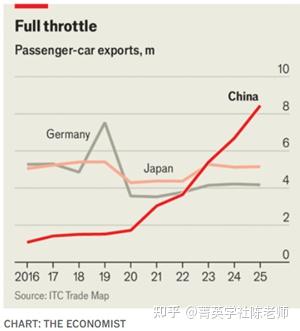
Slowing the pace of China’s blistering rise is vital. The market share of foreign firms in China has almost halved in five years, to around 30% in 2025. Moreover, in 2023 China passed Japan to become the world’s largest exporter of cars (see chart). In 2025 over 8m of its vehicles went abroad, nearly a third more than the year before. In Europe over the past five years, Chinese brands have gone from almost nowhere to nearly 8% of all sales, according to Schmidt Automotive Research, a consultancy. Incumbents are also under siege in markets from Mexico and Brazil to Indonesia and Malaysia.
遏制中国车企迅猛崛起的势头至关重要。过去五年间,外资车企在中国市场的份额几乎腰斩,到2025年已降至约30%。此外,2023年中国超越日本成为全球最大汽车出口国。2025年,中国出口汽车超过800万辆,同比增长近三分之一。据咨询机构施密特汽车研究公司数据,过去五年间,中国汽车品牌在欧洲的市场份额从几乎为零增长至近8%。老牌车企在墨西哥、巴西、印尼、马来西亚等市场同样面临巨大压力。
Chinese cars are cheap. They are also packed with whizzy technology. Often in partnership with local tech giants, the country’s carmakers have developed software that has become an increasingly important source of differentiation; among the latest examples is the integration of voice-controlled artificial-intelligence systems.
中国汽车价格低廉,而且搭载了大量炫目科技。中国车企常与本土科技巨头合作,开发出日益成为差异化重要来源的软件系统。最新案例包括集成语音控制的人工智能系统。
The pace of innovation is stunning. “China speed” has become the “drumbeat” of the industry, says Ola Kallenius, boss of Mercedes. The legacy industry’s product-development cycle—around 40 to 80 months for new models—now looks painfully slow. Production processes designed around electric vehicles (EVs), combined with deep vertical integration and a greater willingness to improve vehicles after they are released via software updates, mean it takes 24 months at most in China. The technology integrated into foreign cars is often two years or more behind Chinese offerings.
创新的速度令人惊叹。梅赛德斯CEO奥拉·康林松表示,“中国速度”已成为行业的“主旋律”。传统车企的产品开发周期——新车型大约需要40至80个月——如今显得惊人地缓慢。围绕电动汽车设计的生产流程,加上深度的垂直整合,以及通过软件更新持续优化车辆的意愿,使得在中国整个周期最多只需24个月。外国车型所集成的技术往往比中国产品落后两年甚至更久。
Incumbent carmakers have begun overhauling their businesses in response. Designing cars in Europe for the world has “had its day”, says Oliver Blume, boss of VW. The carmaker has started developing vehicles at a vast new research-and-development (R&D) facility in Hefei, at a pace 30% faster than in Europe. These will be sold not only in China, but also some overseas markets. Mr Kallenius of Mercedes, which has also expanded its R&D presence in China, argues that the speed of innovation there will have to spread around the world. Even Renault, which does not sell cars in China, is now using the country to hasten its innovation: its latest Twingo model, though designed in France and manufactured in Europe, was developed in China to save time and money and glean know-how.
老牌车企已开始大刀阔斧地改革。大众汽车CEO奥利弗·布鲁姆表示,在欧洲为全球设计汽车的时代“已经过去”。大众在合肥新建的大型研发中心开发新车,速度比在欧洲快30%。这些车型不仅将在中国销售,也将出口部分海外市场。梅赛德斯也扩大了在华研发规模,康林松认为,中国的创新速度必须推广至全球。即便是已不在中国销售汽车的雷诺,如今也利用中国来加速自身创新:其最新Twingo车型虽然设计在法国、制造在欧洲,但开发工作却在中国完成,以节省时间和成本,并获取技术经验。
To help them catch up in EVs, foreign carmakers have also sought the assistance of Chinese firms. VW, which is launching 20 new models in China this year alone, has allied with XPeng, a local carmaker, and Horizon Robotics, an autonomous-driving startup. Toyota, which will make electric versions of its upmarket Lexus brand at a new factory near Shanghai starting in 2027, is working with Huawei and Tencent, two Chinese tech giants that develop software for cars, as well as Momenta, a rival to Horizon Robotics, and Xiaomi, a gadget-maker with a growing EV business of its own. BMW and Nissan have likewise teamed up with local companies.
为了在电动汽车领域迎头赶上,外国车企也纷纷寻求中国企业的帮助。大众今年仅在中国就将推出20款新车型,并与本土车企小鹏汽车以及自动驾驶初创公司地平线机器人达成合作。丰田计划从2027年开始在上海附近的新工厂生产高端品牌雷克萨斯的电动版本,并正与华为、腾讯(两家开发车载软件的中国科技巨头),以及地平线的竞争对手Momenta和自身电动车业务不断扩张的小米公司合作。宝马和日产同样与本土企业结成了联盟。
Rumours of more tie-ups abound. Mercedes reportedly plans to use vehicle architecture from Geely, one of China’s biggest carmakers, to develop small EVs in the country independently of its European operations. Even American carmakers are starting to buddy up with the Chinese. Ford is said to be talking to Geely about sharing technology and making vehicles in Ford’s European factories.
更多合作传闻甚嚣尘上。据称,梅赛德斯计划使用中国最大车企之一吉利的车辆架构,在中国独立于其欧洲业务开发小型电动车。就连美国车企也开始与中国企业交好。据传,福特正与吉利商谈技术共享,并计划在福特的欧洲工厂生产汽车。
Will efforts to become more Chinese work? Pedro Pacheco of Gartner, another consultancy, warns that China speed is not a “magic formula but a mindset” that will be very hard to match. It is the result of a culture of long working hours and an industry that has been built from the start around software-infused EVs. Restructuring legacy carmakers that have relied for decades on petrol power and mechanical engineering will be tough. Mr Blume adds that VW will never be as fast as a Chinese startup because it will never compromise on safety and testing. Get this wrong and the damage to its reputation could be serious.